
Cardiac muscle cells and striated muscle fibresSpec B2.3.9
In short
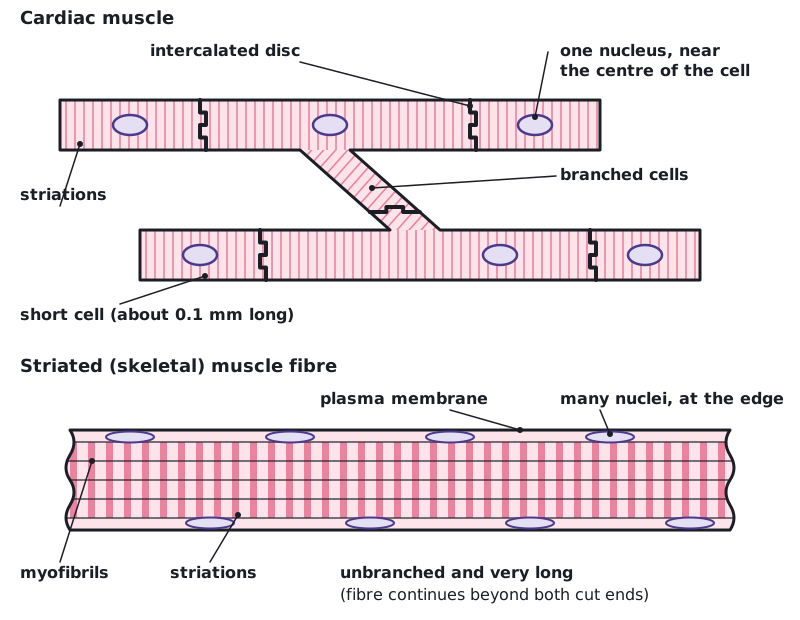
Cardiac muscle cells and striated muscle fibres both contain contractile myofibrils. Cardiac muscle cells are short, branched and usually have one nucleus, joined end to end so impulses spread through the heart wall. Striated muscle fibres are unbranched, very long and multinucleate because they form by fusion of many cells, so they are atypical cells.
Both types contain contractile myofibrils, which give a striped (striated) appearance and shorten when the muscle contracts. They differ in branching, length and number of nuclei.
| Feature | Cardiac muscle cells | Striated (skeletal) muscle fibres |
|---|---|---|
| Contractile myofibrils | Present | Present |
| Branching | Branched | Unbranched |
| Length | Short (about 0.1 mm) | Very long (up to many centimetres) |
| Nuclei | Usually one, near the centre | Many, near the edge of the fibre |
| Connections | Joined end to end at intercalated discs | Lie side by side, each stimulated by a motor neuron |
Hypotheses for the differences
- Branching: cardiac cells branch and join at intercalated discs, forming a network, so impulses spread quickly through the heart wall and the heart contracts as a coordinated unit.
- Length: a striated muscle fibre is long so that one stimulus makes the whole fibre contract along its length at the same time.
- Number of nuclei: one nucleus may not be able to supply enough mRNA for the proteins of a very large volume of cytoplasm, so a long fibre has many nuclei spread along it. A short cardiac cell needs only one.
Is a striated muscle fibre a cell?
A striated muscle fibre is surrounded by one continuous plasma membrane, as a cell is. But it forms during development when many muscle precursor cells fuse together, and it contains many nuclei, so it does not fit the usual idea of a cell as a unit with one nucleus. It can be argued either way: it is often described as an atypical cell, an exception to the cell theory, or as a fused structure rather than a single cell.
 (opens full size in a new tab)
In a 'discuss' question on whether a muscle fibre is a cell, give evidence on both sides and finish with a reasoned conclusion.
Written and checked against the IB Biology HL specification · Updated October 2026