
The Golgi apparatus and vesiclesSpec B2.2.8, B2.2.9
In short
The Golgi apparatus is a stack of flattened membrane sacs that processes proteins from the rough ER and packages them into vesicles for secretion. Vesicles are small membrane-bound sacs that carry materials around the cell. The protein clathrin forms a cage-like coat on the cytoplasmic side of a membrane, curving it into a bud that pinches off as a vesicle.
The Golgi apparatus
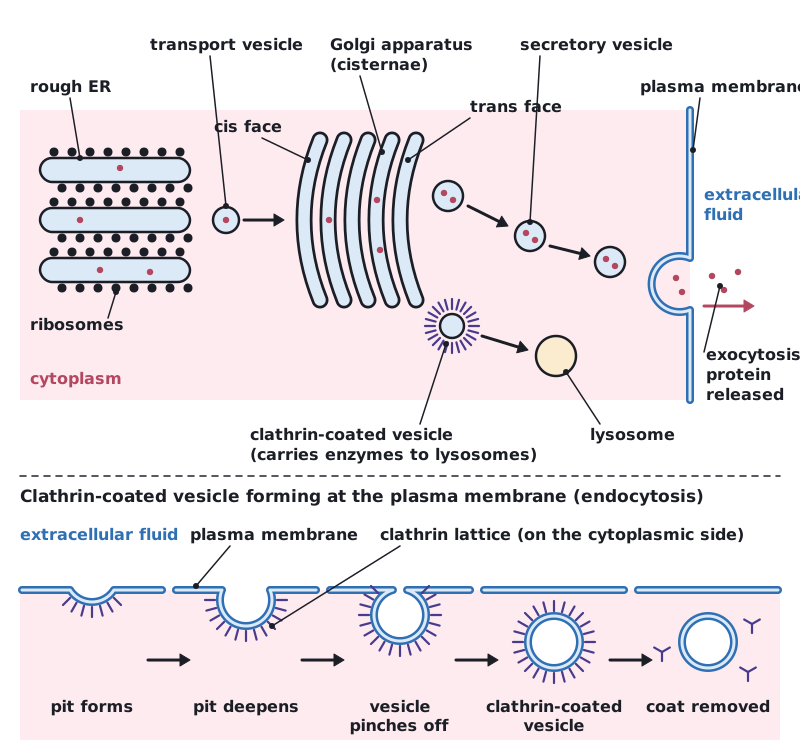
The Golgi apparatus is a stack of flattened, curved membrane sacs (cisternae) that are not joined to each other. Vesicles from the rER fuse with the cis face, nearest the rER. Proteins are processed as they pass through the cisternae, for example by adding or changing carbohydrate chains to make glycoproteins. At the trans face, processed proteins are packed into vesicles that bud off.
- A protein is made by ribosomes on the rER and enters the rER lumen.
- Vesicles bud off the rER and carry the protein to the cis face of the Golgi apparatus.
- The protein is processed as it moves through the Golgi cisternae.
- Secretory vesicles bud from the trans face and move to the plasma membrane.
- The vesicle membrane fuses with the plasma membrane and the protein is released by exocytosis.
Cells that secrete a lot of protein, such as pancreatic cells that make digestive enzymes and plasma cells that make antibodies, have extensive rER and a large Golgi apparatus.
Vesicles and clathrin
Vesicles are small spheres of membrane enclosing fluid. They carry materials within the cell (for example from the rER to the Golgi apparatus), carry proteins for secretion, deliver hydrolytic enzymes as lysosomes and bring material in by endocytosis. Because membranes are fluid, vesicles can bud off one membrane and fuse with another.
Clathrin is a protein that helps vesicles form. Clathrin molecules assemble into a basket-shaped lattice on the cytoplasmic side of a membrane: at the plasma membrane during endocytosis, and at the trans face of the Golgi apparatus for vesicles carrying enzymes towards lysosomes. The lattice pulls the membrane into a curved pit that deepens and pinches off as a clathrin-coated vesicle. The coat is then removed so the vesicle can fuse with its target membrane. Vesicles travelling from the rER to the Golgi apparatus use different coat proteins, whose names are not required.
 (opens full size in a new tab)
The Golgi apparatus does not make proteins. Ribosomes on the rER make them; the Golgi apparatus processes them and packages them into vesicles.
Quick check
Name two structures that are not considered organelles.
Show answer
Any two of: the cell wall, the cytoskeleton, the cytoplasm.
In cell fractionation, which organelles form a pellet first, at the lowest speed?
Show answer
Nuclei.
Why must the hydrolytic enzymes of lysosomes be kept in a compartment?
Show answer
So they do not digest the cell's own molecules, and so they can be concentrated at their acid optimum pH.
HL only Which part of the mitochondrion contains the enzymes of the Krebs cycle?
Show answer
The matrix.
HL only What is the role of clathrin?
Show answer
It forms a coat that curves a membrane into a bud, forming a vesicle.
Written and checked against the IB Biology HL specification · Updated October 2026