
Haemoglobin, the Bohr shift and oxygen dissociation curvesSpec B3.1.11, B3.1.12, B3.1.13
In short
Haemoglobin binds oxygen cooperatively: when one oxygen binds to a haem group, the shape of the molecule changes so the other haem groups bind oxygen more easily. This gives an S-shaped dissociation curve. Foetal haemoglobin has a higher affinity than adult haemoglobin, and carbon dioxide lowers affinity, the Bohr shift.
Adult haemoglobin is made of four polypeptide chains (two alpha and two beta), each with a haem group containing an iron ion that binds one O₂ molecule. One haemoglobin molecule carries up to four O₂ molecules.
Cooperative binding
When the first O₂ binds, the conformation of the whole molecule changes, so the remaining haem groups bind O₂ more easily. This is cooperative binding. In the same way, when one O₂ is released, the others are released more easily.
Oxygen dissociation curves
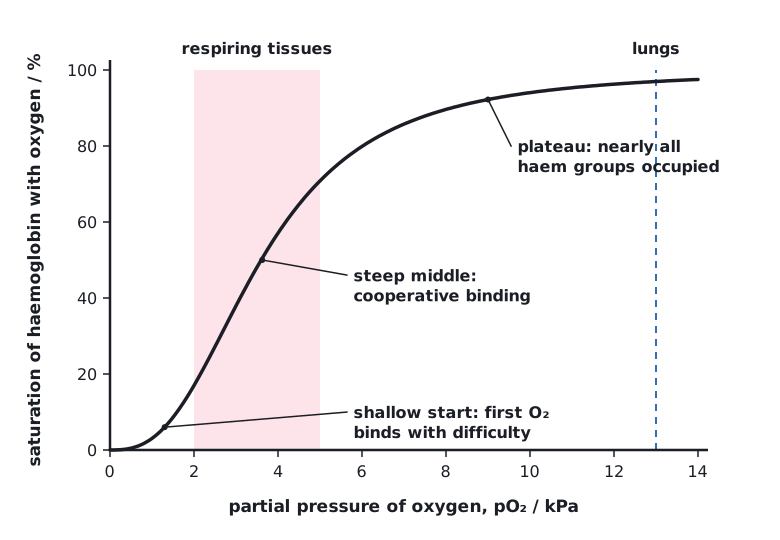
An oxygen dissociation curve plots percentage saturation of haemoglobin against partial pressure of oxygen (pO₂, kPa). It shows the affinity of haemoglobin for oxygen at different oxygen concentrations.
- At low pO₂ the curve is shallow: binding the first O₂ is difficult.
- In the middle the curve is steep: cooperative binding makes each further O₂ bind more easily.
- At high pO₂ the curve levels off: almost all haem groups are occupied, so in the lungs (about 13 kPa) haemoglobin is nearly saturated even if pO₂ falls a little.
- The steep part matches the pO₂ in respiring tissues, so a small drop in pO₂ releases a large amount of oxygen.
Bohr shift
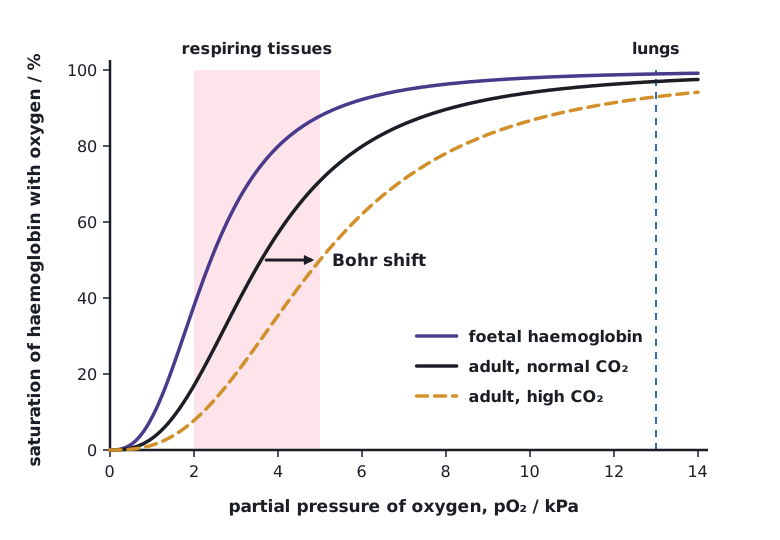
Carbon dioxide binds allosterically to haemoglobin, at sites other than the haem groups (the amino groups at the ends of the globin chains), and this lowers its affinity for oxygen. CO₂ also reacts with water in red blood cells to form carbonic acid, and the hydrogen ions released bind to haemoglobin as well, lowering its affinity further. So a rise in CO₂ (and the fall in pH that goes with it) moves the dissociation curve to the right: the Bohr shift. At the same pO₂, haemoglobin is then less saturated, so more oxygen dissociates. Actively respiring tissues produce more CO₂, so haemoglobin releases more oxygen exactly where it is needed. In the lungs CO₂ is low, so affinity is higher and oxygen loading is efficient.
Foetal and adult haemoglobin
Foetal haemoglobin has two gamma chains in place of the beta chains, and a higher affinity for oxygen than adult haemoglobin. Its curve lies to the left of the adult curve, so in the placenta, at a pO₂ where maternal haemoglobin releases oxygen, foetal haemoglobin takes it up.
 (opens full size in a new tab)
 (opens full size in a new tab)
Curve to the left means higher affinity (loads more easily); curve to the right means lower affinity (unloads more easily). Always say what happens to affinity.
The Bohr shift does not mean CO₂ competes with oxygen for the haem groups. CO₂ and hydrogen ions bind elsewhere on the globin and change the molecule's shape, lowering its affinity for oxygen.
Quick check
What happens to the surface area-to-volume ratio as an organism grows larger?
Show answer
It decreases.
What is the function of surfactant in the alveoli?
Show answer
It reduces surface tension so the alveoli do not stick together and collapse when air is breathed out.
Which three volumes add up to the vital capacity?
Show answer
Tidal volume, inspiratory reserve volume and expiratory reserve volume.
Why does increased humidity reduce the rate of transpiration?
Show answer
It reduces the concentration gradient of water vapour between the air spaces and the outside air.
HL only In which direction does high carbon dioxide shift the oxygen dissociation curve?
Show answer
To the right (lower affinity, more oxygen released): the Bohr shift.
Written and checked against the IB Biology HL specification · Updated October 2026