
Barriers to hybridization and abrupt speciation by polyploidySpec A4.1.10, A4.1.11
In short
Barriers to hybridization, such as species-specific courtship behaviour, and the sterility of interspecific hybrids prevent the mixing of alleles between species. A mule is a sterile hybrid because its chromosomes cannot pair in meiosis. In plants, hybridization followed by doubling of the chromosome number gives a fertile polyploid that is isolated from its parents: abrupt speciation, as in Persicaria.
Once species have formed, two kinds of mechanism stop their alleles mixing: barriers that prevent hybrids forming, and sterility of interspecific hybrids when they do form.
Barriers to hybridization
In animals, courtship behaviour often prevents hybridization. Courtship signals such as songs, dances, displays, flash patterns or scents are species-specific, so an individual responds only to a mate of its own species. Breeding at different times (temporal isolation) also prevents mating.
Sterile hybrids: the mule
A mule is the hybrid of a male donkey and a female horse. Horses have 64 chromosomes and donkeys 62, so a mule has 63: 32 from its horse parent and 31 from its donkey parent. In meiosis these chromosomes cannot form homologous pairs, so the mule cannot produce viable gametes and is sterile.
Because mules almost never reproduce, no horse alleles pass into the donkey gene pool through them, or donkey alleles into the horse gene pool. The two species stay separate even though they can hybridize.
Abrupt speciation in plants
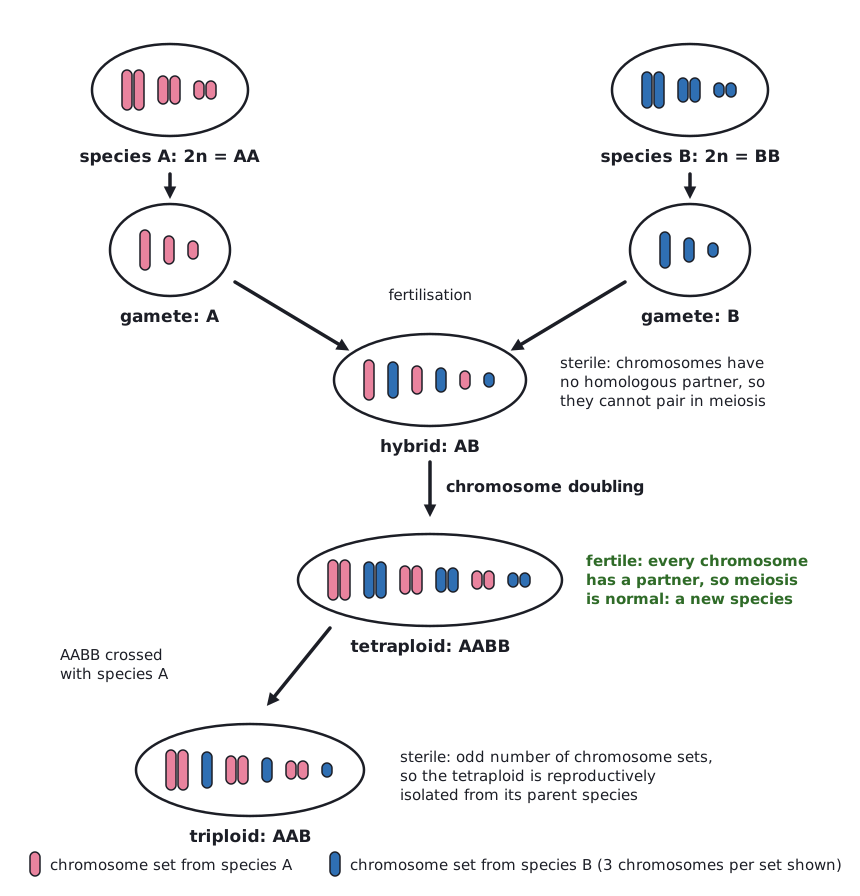
Polyploidy is having more than two sets of chromosomes. Combined with hybridization it can create a new plant species in a single generation.
- Two related species hybridize. The hybrid has one set of chromosomes from each parent, and these sets are not homologous.
- The hybrid is sterile because its chromosomes cannot pair up in meiosis.
- The chromosome number doubles, for example when chromosomes are copied but the cell does not divide. Now every chromosome has a homologous partner.
- The polyploid can carry out meiosis normally and is fertile.
- If it crosses with either parent, the offspring have an odd number of chromosome sets and are sterile. The polyploid is reproductively isolated from both parents: it is a new species.
Plants form species this way more easily than animals because many can self-pollinate or reproduce asexually, so a single polyploid individual can found a population.
Knotweeds and smartweeds (genus Persicaria) are an example. The genus contains many species formed by hybridization and polyploidy. Molecular studies suggest that about 15 species in the genus are allopolyploids, mostly tetraploids whose chromosome sets come from two different ancestral species, with at least one hexaploid. One diploid species, pale smartweed (Persicaria lapathifolia), has been a parent in at least six of these origins.
 (opens full size in a new tab)
In polyploidy answers explain why the hybrid is sterile (no homologous pairs in meiosis) and why doubling fixes it (each chromosome now has a partner). Either the common or scientific name of Persicaria is accepted.
Quick check
Define evolution.
Show answer
Change in the heritable characteristics of a population.
What do fewer differences in the amino acid sequence of a protein between two species suggest?
Show answer
They shared a common ancestor more recently.
Name the five groups of bones in a pentadactyl forelimb.
Show answer
Humerus; radius and ulna; carpals; metacarpals; phalanges.
What two processes are needed for speciation?
Show answer
Reproductive isolation and differential selection.
HL only Why is a mule sterile?
Show answer
Its 63 chromosomes cannot form homologous pairs in meiosis, so it cannot make viable gametes.
Written and checked against the IB Biology HL specification · Updated October 2026