
Non-competitive and competitive inhibitionSpec C1.1.14, C1.1.15
In short
A non-competitive inhibitor binds reversibly to an allosteric site, away from the active site, causing a conformational change that alters the active site enough to prevent catalysis; more substrate cannot reverse this. A competitive inhibitor, such as a statin, resembles the substrate and binds reversibly to the active site, so high substrate concentrations can overcome it.
Allosteric sites and non-competitive inhibition
An allosteric site is a binding site on an enzyme other than the active site. Only specific substances can bind to it. When an inhibitor binds there, it causes interactions within the enzyme that lead to a conformational change: the shape of the protein changes, altering the active site enough to prevent catalysis. The substrate may still bind, but the reaction does not happen. Binding is reversible.
This is non-competitive inhibition: the inhibitor does not compete with the substrate for the active site. Adding more substrate does not remove the inhibitor, so the maximum rate is lowered at every substrate concentration.
Competitive inhibition
A competitive inhibitor has a shape and chemistry similar to the substrate. It binds reversibly to the active site, blocking it, but is not converted into products. Substrate and inhibitor compete for the same site, so the proportion of active sites occupied by substrate depends on their relative concentrations. At high substrate concentrations the substrate wins most collisions, so the rate approaches the same maximum as without inhibitor.
Statins are competitive inhibitors used as drugs to lower blood cholesterol. They inhibit an enzyme in the liver (HMG-CoA reductase) that catalyses a step in the pathway that synthesises cholesterol.
| Competitive | Non-competitive | |
|---|---|---|
| Where the inhibitor binds | Active site | Allosteric site |
| Shape of inhibitor | Similar to the substrate | Not similar to the substrate |
| Interaction with substrate | Inhibitor and substrate compete for the active site | No competition; both can bind at once |
| Effect of raising substrate concentration | Overcomes inhibition; maximum rate eventually reached | Does not overcome inhibition; maximum rate lowered |
| Example | Statins | End-product inhibitors acting at allosteric sites |
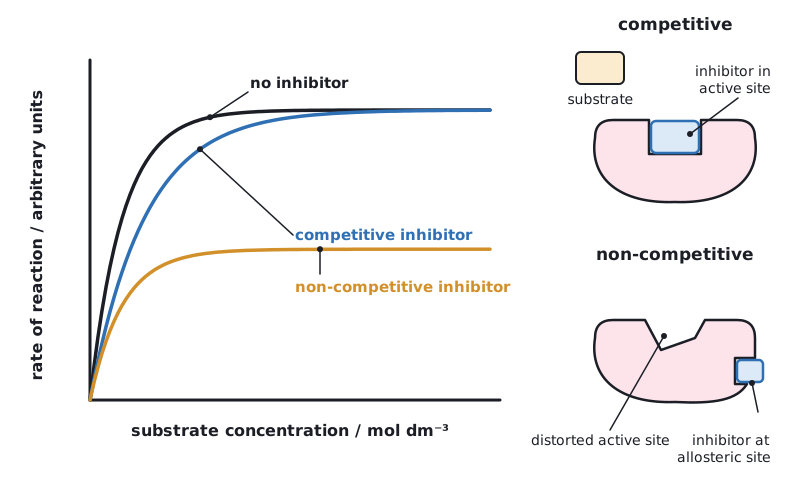 (opens full size in a new tab)
To tell the types apart from a graph, look at high substrate concentrations: if the inhibited curve reaches the uninhibited maximum, the inhibitor is competitive.
Written and checked against the IB Biology HL specification · Updated October 2026