
Monosaccharides: form and functionSpec B1.1.4
In short
Monosaccharides are single sugar units, such as pentoses with five carbon atoms (ribose, deoxyribose) and hexoses with six (glucose). Glucose suits its role because it is soluble, so it is easily transported in blood plasma; chemically stable, so it does not react while stored or carried; and yields energy when oxidised in cell respiration.
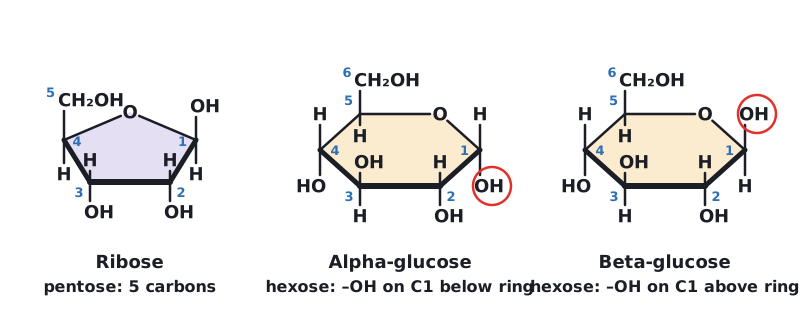
Monosaccharides are the monomers of carbohydrates. In water they mostly exist as rings. You need to recognise two groups from ring diagrams.
| Group | Carbon atoms | Ring | Examples |
|---|---|---|---|
| Pentose | 5 | Five-membered ring: four carbons and one oxygen; C5 sits outside the ring | Ribose, deoxyribose |
| Hexose | 6 | Glucose and galactose: six-membered ring of five carbons and one oxygen, with C6 (CH₂OH) outside the ring. Fructose: five-membered ring, with C1 and C6 outside | Glucose, galactose, fructose |
To identify a sugar from a diagram, count all the carbon atoms, including any outside the ring. Five means pentose, six means hexose. Fructose is a hexose even though it forms a five-membered ring.
Glucose (C₆H₁₂O₆) exists as alpha-glucose and beta-glucose. They differ only at carbon 1: in alpha-glucose the –OH on C1 is below the ring; in beta-glucose it is above the ring.
 (opens full size in a new tab)
Glucose: properties linked to use
| Property | Reason | Use |
|---|---|---|
| Soluble | Polar –OH groups form hydrogen bonds with water | Dissolves in cytoplasm and blood plasma |
| Transportable | Small and soluble | Carried in blood plasma to every cell |
| Chemically stable | The ring structure does not react readily | Can be carried and held in cells without unwanted reactions |
| Yields energy when oxidised | Oxidation releases energy, captured as ATP in cell respiration | The main respiratory substrate in most cells |
Its solubility is also a drawback for storage: a high concentration of glucose would draw water into cells by osmosis. So glucose is stored as polysaccharides instead.
Linking question: what are the roles of oxidation and reduction? Oxidising glucose to carbon dioxide and water in respiration releases energy; reducing carbon dioxide in photosynthesis stores it.
Written and checked against the IB Biology HL specification · Updated October 2026