
Variables affecting the rate of cell respirationSpec C1.2.6
In short
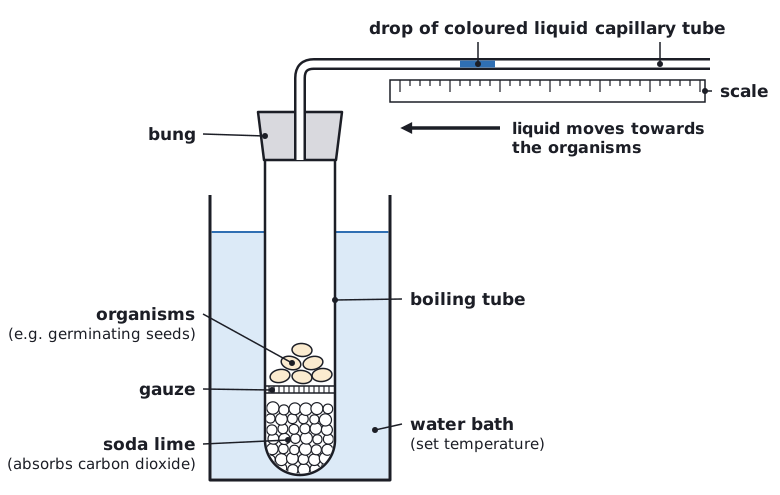
The rate of cell respiration can be measured as oxygen used or carbon dioxide produced per unit time, often per gram of organism. Variables that affect it include temperature, oxygen concentration and the availability of respiratory substrate. A simple respirometer with an alkali to absorb carbon dioxide measures oxygen uptake from the movement of a liquid drop.
The rate of cell respiration is the amount of oxygen used, carbon dioxide produced or substrate used per unit time. To compare organisms of different sizes, divide by mass, for example mm³ of oxygen per gram per minute.
Variables that affect the rate
- Temperature: respiration is enzyme-catalysed, so rate rises to an optimum, then falls as enzymes denature.
- Oxygen concentration: low oxygen limits aerobic respiration.
- Substrate availability: for example glucose concentration for yeast, or stored food in germinating seeds.
- Others: type and activity of the organism, pH, and stage of development (germinating seeds respire faster than dry seeds).
 (opens full size in a new tab)
Measuring the rate
- Place a known mass of organisms (for example germinating seeds or invertebrates) in a sealed tube with an alkali such as soda lime to absorb carbon dioxide.
- Keep the tube in a water bath at a set temperature and let it equilibrate.
- Record the distance the liquid drop moves in a fixed time.
- Set up a control tube with glass beads of the same volume instead of organisms, to correct for temperature and pressure changes.
- Repeat at different values of the independent variable (for example temperature) and calculate rates.
Rates can also be measured with oxygen or carbon dioxide sensors and a data logger, or for yeast by measuring the volume of carbon dioxide released.
Rate of respiration from a respirometer
2.5 g of germinating seeds were placed in a respirometer. The drop in the capillary tube (radius 0.50 mm) moved 30 mm in 10 minutes. Calculate the rate of oxygen uptake per gram.
- Volume of oxygen = πr²h = 3.14 × 0.50² × 30 = 23.6 mm³.
- Rate = 23.6 mm³ ÷ 10 min = 2.36 mm³ min⁻¹.
- Per gram: 2.36 ÷ 2.5 = 0.94 mm³ g⁻¹ min⁻¹.
Answer: 0.94 mm³ g⁻¹ min⁻¹ (to 2 significant figures).
Rate = amount ÷ time. Always state units, and divide by mass when organisms or samples differ in size.
Use living organisms ethically: handle invertebrates gently, use gauze to keep them away from the corrosive soda lime, and return them to their habitat afterwards.
Written and checked against the IB Biology HL specification · Updated October 2026