
Separating photosynthetic pigments by chromatographySpec C1.3.4
In short
Chromatography separates photosynthetic pigments because each pigment has a different solubility in the solvent and attraction to the paper or thin-layer plate, so they travel different distances. Pigments are identified by colour and by Rf value, which is the distance moved by the pigment divided by the distance moved by the solvent front. Paper or thin-layer chromatography can be used.
Leaves contain several photosynthetic pigments. They can be separated by chromatography, using paper or a thin-layer chromatography (TLC) plate. Each pigment travels a different distance because it differs in how soluble it is in the solvent and how strongly it is attracted to the stationary phase.
- Grind leaf tissue with a little sand and propanone (or another suitable solvent) to extract the pigments.
- Draw a pencil origin line about 1 cm from the bottom of the paper or plate.
- Apply a small, concentrated spot of extract to the origin, letting it dry between applications.
- Stand the paper or plate in a small depth of running solvent, below the origin, in a covered container.
- Remove it when the solvent is near the top and immediately mark the solvent front with pencil.
- Mark the centre of each pigment spot, measure distances from the origin and calculate Rf values.
Rf values are always between 0 and 1 and have no units. Pigments are identified by their colour and by comparing their Rf values with reference values for the same solvent and stationary phase.
| Pigment | Colour on the chromatogram |
|---|---|
| Carotene | Orange-yellow (usually travels furthest) |
| Xanthophylls | Yellow |
| Chlorophyll a | Blue-green |
| Chlorophyll b | Yellow-green |
Calculating an Rf value
On a chromatogram the solvent front moved 8.0 cm from the origin. A blue-green spot moved 4.4 cm. Calculate its Rf value.
- Rf = distance moved by pigment ÷ distance moved by solvent front.
- Rf = 4.4 ÷ 8.0 = 0.55.
Answer: Rf = 0.55 (no units). With its blue-green colour this is likely chlorophyll a; confirm with reference values for the same method.
Use a pencil for the origin (ink would separate too), keep the origin above the solvent, and measure to the centre of each spot. Rf values depend on the solvent and medium, so only compare with references from the same method.
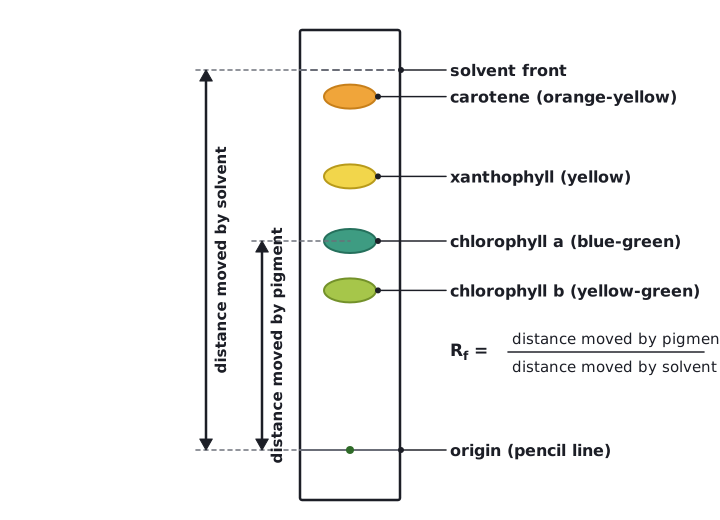 (opens full size in a new tab)
Written and checked against the IB Biology HL specification · Updated October 2026