
The terms lytic and latencySpec 6.5(ii)
In short
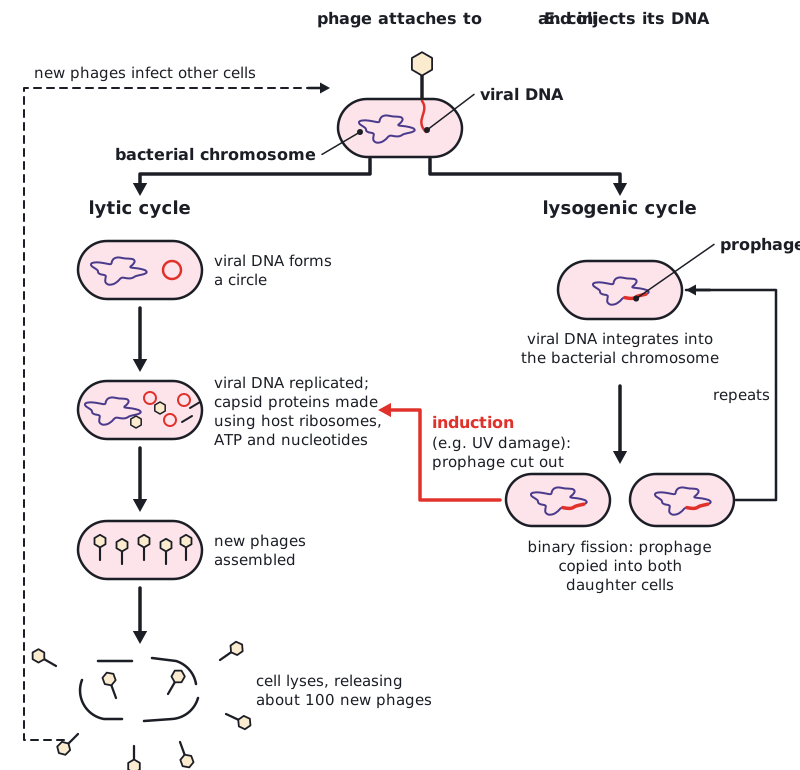
In the lytic cycle a virus takes over the host cell, makes many new virus particles and bursts the cell open to release them. In latency the viral genome stays in the host cell, often integrated into the host DNA, without producing virus, and can later be triggered into the lytic cycle.
- Lytic cycle
- A viral life cycle in which the virus uses the host cell to make many copies of itself at once; the host cell bursts (lyses) and releases the new particles.
- Latency
- A state in which viral nucleic acid persists in the host cell without producing new virus particles, and no symptoms need occur; the virus can later become active.
The lytic cycle (for example lambda phage)
- Attachment: tail fibres bind to specific receptors on the bacterial surface.
- Injection: the phage DNA enters the bacterium; the empty capsid stays outside.
- Replication and synthesis: the host's enzymes and ribosomes copy the viral DNA and make viral capsid proteins.
- Assembly: new capsids form and are filled with DNA.
- Lysis: viral lysozyme breaks down the cell wall; the host bursts and releases hundreds of phage particles.
Latency (the lysogenic state of lambda phage; HIV)
In latency the viral DNA is inserted into the host chromosome. In a bacterium it is called a prophage and in a human cell infected by HIV, a provirus (made by reverse transcriptase from the RNA genome). It is copied each time the host DNA replicates and passed to daughter cells, and the host cell is not destroyed. A trigger such as stress, ultraviolet light or activation of the infected cell switches the virus into the lytic cycle.
| Feature | Lytic cycle | Latency |
|---|---|---|
| Viral nucleic acid | Replicated separately from the host DNA; many copies made | Integrated into host DNA (or held silent) |
| New virus particles | Made at once in large numbers | None made |
| Host cell | Destroyed (lysed) | Survives and divides |
| Symptoms | Usually during the lytic phase | Often none; the host can be a hidden carrier |
Latent HIV in a provirus is protected from the immune system and antiviral drugs because no viral proteins are being made. That is why people with HIV need life-long treatment.
 (opens full size in a new tab)
Written and checked against the Edexcel International A Level Biology (YBI11) specification · Updated October 2026