
Passive transport: diffusion, facilitated diffusion, channel and carrier proteinsSpec 2.5
In short
Passive transport moves substances across a membrane down a concentration gradient without using ATP. Diffusion occurs directly through the phospholipid bilayer; facilitated diffusion uses channel proteins or carrier proteins for ions and polar molecules, which cannot cross the hydrophobic core of the bilayer.
Passive transport is the movement of substances across a membrane without the cell supplying metabolic energy (no ATP is used). The substance moves down its concentration (or electrochemical) gradient, using the kinetic energy of its own molecules. There are two kinds: diffusion and facilitated diffusion.
Diffusion
Diffusion is the net movement of molecules or ions from a region of higher concentration to a region of lower concentration, down a concentration gradient. Small non-polar molecules such as oxygen and carbon dioxide diffuse directly through the phospholipid bilayer.
Facilitated diffusion
Ions and polar molecules (such as glucose) cannot cross the hydrophobic centre of the bilayer. Facilitated diffusion is passive transport through the membrane with the help of transport proteins. There are two types of protein.
| Feature | Channel protein | Carrier protein |
|---|---|---|
| Structure | Water-filled pore through the membrane, lined with hydrophilic amino acids; often gated (opens and closes). | Has a binding site specific to one molecule or ion, on one side of the membrane. |
| How it works | Ions or small polar molecules of the right size and charge pass through the pore. | The molecule binds, the protein changes shape (conformation) and releases the molecule on the other side. |
| Specificity | Specific to particular ions by pore size and charge. | Specific to a particular molecule by the shape of the binding site. |
| Energy | Passive: no ATP. | Passive in facilitated diffusion: no ATP. |
The rate of facilitated diffusion rises with the concentration gradient, but only up to a point. When all the carrier proteins are working at their maximum rate (saturated), adding more of the substance does not increase the rate. The rate also depends on the number of transport proteins in the membrane.
'Facilitated diffusion' still needs a concentration gradient and still uses no ATP. Say 'down a concentration gradient through a channel or carrier protein' to earn the marks.
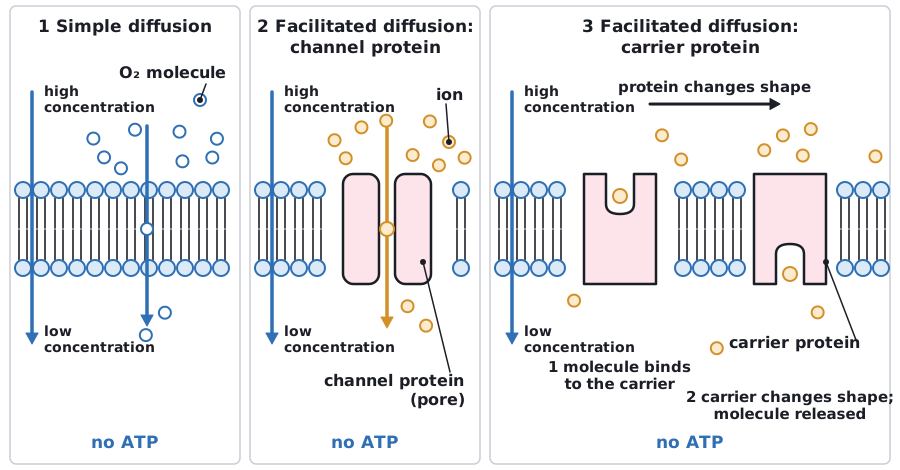 (opens full size in a new tab)
Written and checked against the Edexcel International A Level Biology (YBI11) specification · Updated October 2026