
The development of drug testingSpec 4.13
In short
Early drug testing, such as William Withering's work on digitalis soup, relied on observing patients without proper controls. Modern testing uses laboratory and animal tests, then three phases of clinical trials, with placebos, random allocation and double-blind design. These reduce bias and the placebo effect, and protect the safety of patients.
Historic testing: William Withering and digitalis soup
In the 18th century, William Withering investigated a traditional herbal mixture ('digitalis soup') used to treat dropsy (swelling due to fluid build-up, often caused by heart failure). He found that foxglove was the active ingredient. He recorded the effects of different doses on his patients, and found the dose that worked without causing toxic effects. His work showed that plants contain active chemicals, but there was no control group, no placebo, patients and doctor knew the treatment and the results were open to bias.
Modern drug testing
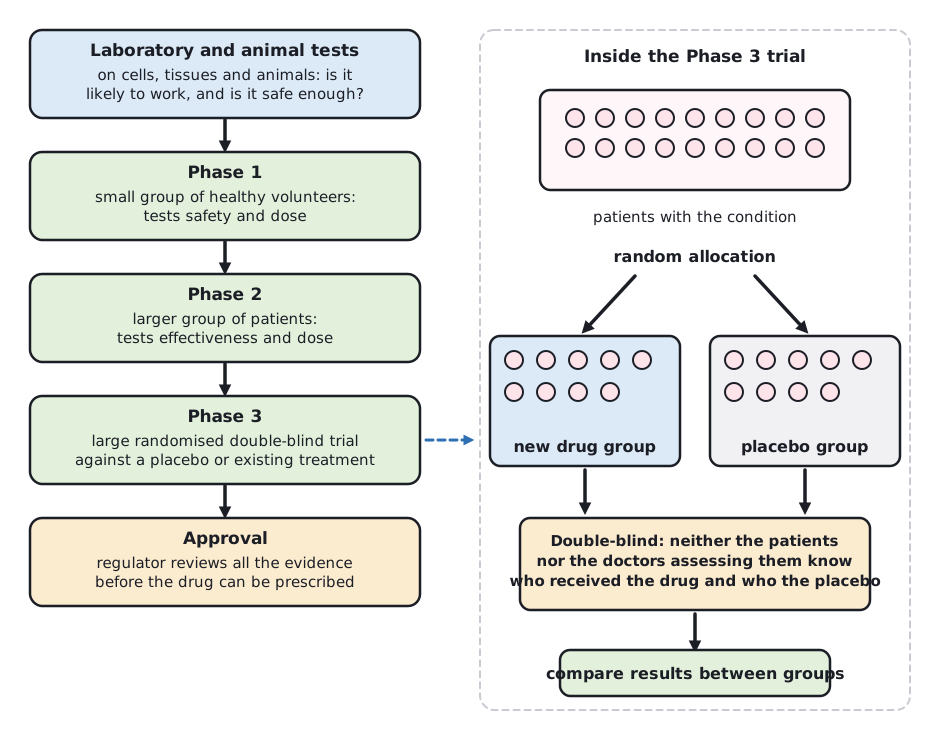
- Laboratory tests: computer models, then tests on cells and tissues, and on animals, to check effects, toxicity and dose.
- Phase 1: a small number of healthy volunteers receive the drug to test safety, side effects and how the body handles it.
- Phase 2: a larger group of patients with the condition is given the drug to find out whether it works and what dose is best.
- Phase 3: a very large group of patients, in a randomised, controlled trial, compares the new drug with a placebo or the best existing treatment to confirm effectiveness and side effects.
- Placebo
- An inactive substance that looks identical to the drug, given to the control group so the effect of the drug can be separated from the effect of believing one is being treated.
- Double-blind trial
- A trial in which neither the patients nor the doctors and researchers assessing them know who is receiving the drug and who is receiving the placebo, to avoid bias.
Why these features matter
- A control group and placebo allow for the placebo effect, where patients improve because they expect to.
- Random allocation makes the groups similar in age, health and other factors.
- Double-blind design stops patients and doctors influencing the results, consciously or not.
- Large samples reduce the effect of chance and allow rare side effects to be detected.
- Patients must give informed consent, and trials can be stopped if the drug causes harm or is clearly beneficial.
 (opens full size in a new tab)
If asked why a trial is double-blind, say who is not told (patients and the researchers assessing them) and what this prevents (bias). If asked why a placebo is used, mention the placebo effect.
Quick check
Name two nutrients that bacteria need to grow.
Show answer
A carbon source (for example glucose) and a nitrogen source (for amino acids), plus mineral ions.
Why is a Bunsen burner lit during aseptic work?
Show answer
Rising hot air carries microorganisms away from the work area, reducing contamination.
What does a zone of inhibition show?
Show answer
That the substance inhibits bacterial growth.
What is a placebo?
Show answer
An inactive substance that looks the same as the drug, given to the control group.
What is the purpose of Phase 1 of a clinical trial?
Show answer
To test the safety, side effects and dose of a drug on a small number of healthy volunteers.
Written and checked against the Edexcel International A Level Biology (YBI11) specification · Updated October 2026