
Water as a solvent in transportSpec 1.1
In short
Water is an effective solvent because its molecules are dipoles: oxygen is slightly negative and each hydrogen slightly positive. Water molecules cluster around ions and polar molecules, separating and dispersing them. This is why dissolved substances can be transported in blood plasma, xylem sap and phloem sap, while non-polar lipids cannot dissolve.
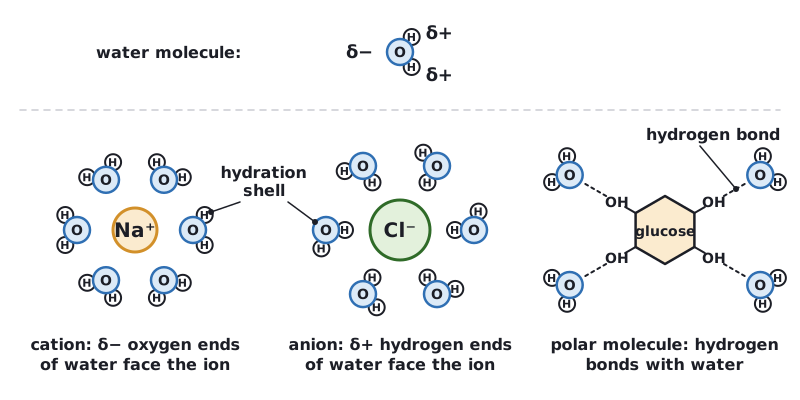
A water molecule (H₂O) has one oxygen atom bonded to two hydrogen atoms. Oxygen attracts the shared electrons more strongly than hydrogen does, so the oxygen end carries a small negative charge (δ−) and each hydrogen end a small positive charge (δ+). The molecule is overall neutral, but its charge is unevenly spread. This makes water a dipole, and a polar molecule.
 (opens full size in a new tab)
Ions (for example Na⁺, Cl⁻, HCO₃⁻) and polar molecules (for example glucose, amino acids, urea) are attracted to the oppositely charged ends of water molecules. Water molecules cluster around each solute particle, separate it from its neighbours and keep it dispersed. The result is a solution, in which the solute particles move freely and can be carried along by the flow of the liquid.
| Transport system | Substances carried in solution |
|---|---|
| Blood plasma | Glucose, amino acids, mineral ions, hydrogencarbonate ions, urea, hormones |
| Xylem sap in plants | Water with dissolved mineral ions |
| Phloem sap in plants | Sucrose and amino acids |
| Urine (excretion) | Urea and excess ions in solution |
Non-polar molecules such as triglycerides and cholesterol are hydrophobic: they are not attracted to water, so they do not dissolve in blood plasma. They have to be carried in other ways (see lipoproteins, in the section on cholesterol, HDL and LDL).
- Dipole
- A molecule with a slightly positive end and a slightly negative end because its electrons are unevenly shared.
- Solvent
- A liquid in which other substances (solutes) dissolve to form a solution.
Link the dipole to the dissolving. Say that the charged ends of water molecules are attracted to ions or polar molecules and surround them. 'Water is polar' on its own does not earn the mark.
Written and checked against the Edexcel International A Level Biology (YBI11) specification · Updated October 2026