
Isolation and speciationSpec 5.24
In short
A species is a group of organisms that can interbreed to produce fertile offspring. Isolation reduces gene flow between populations, so different mutations and selection pressures cause their allele frequencies to diverge. If they can no longer interbreed, new species form: allopatric speciation after geographical isolation, or sympatric speciation within the same area.
A species is a group of organisms that can interbreed to produce fertile offspring. Gene flow is the movement of alleles between populations by interbreeding. Speciation is the formation of new species. It requires that gene flow between populations is reduced or stopped by isolation.
Allopatric speciation
- A population is divided by a geographical barrier such as a mountain range, river, sea or desert. The two populations can no longer interbreed, so there is no gene flow between them.
- Mutations occur independently in each population, and the selection pressures differ between the two environments.
- Allele frequencies in the two gene pools gradually diverge.
- Eventually the populations are so different (for example in courtship behaviour, breeding time, or gamete compatibility) that if they came into contact again they could not interbreed to produce fertile offspring. They are now separate species.
Sympatric speciation
In sympatric speciation, new species form within the same geographical area, without a physical barrier. Reproductive isolation arises in other ways:
- Ecological or habitat isolation: groups use different parts of the habitat or different food sources.
- Temporal isolation: groups breed at different times of the year or day.
- Behavioural isolation: changes in courtship behaviour mean that individuals do not recognise each other as mates.
- Polyploidy (common in plants): an error in cell division (for example meiosis that produces gametes with two sets of chromosomes) doubles the number of chromosome sets. The polyploid plants cannot produce fertile offspring with the parent species (a cross gives sterile offspring), but they can reproduce with each other or by self-pollination.
| Feature | Allopatric | Sympatric |
|---|---|---|
| Location | Populations in different areas | Populations in the same area |
| Cause of isolation | Geographical barrier | Ecological, temporal, behavioural or genetic changes |
| Gene flow | Stopped by the barrier | Reduced by reproductive isolation |
| Outcome | Different allele frequencies, new species | Different allele frequencies, new species |
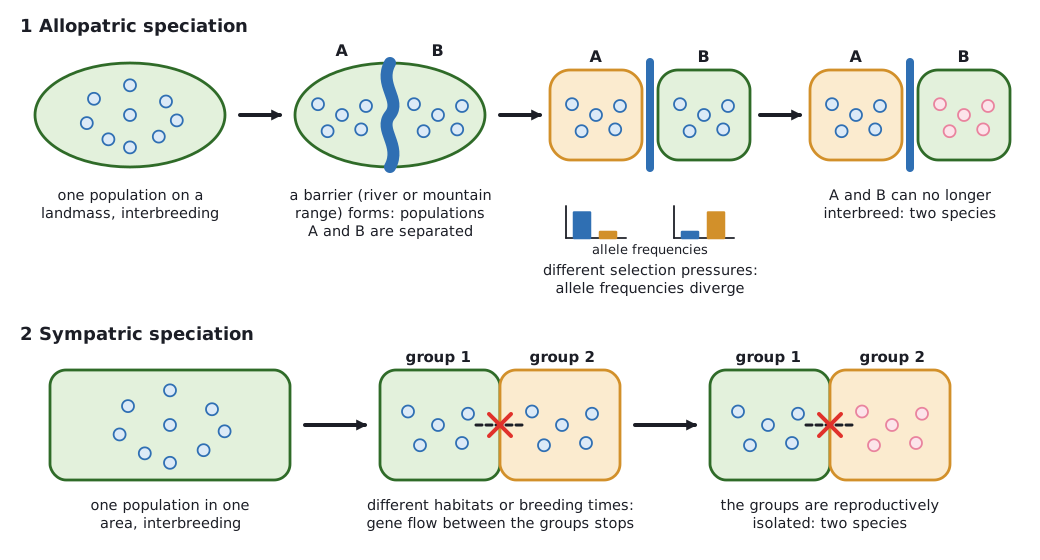 (opens full size in a new tab)
Always include the same logic: isolation, so no gene flow, so different mutations and selection, so allele frequencies diverge, so no interbreeding (reproductive isolation), so new species.
Quick check
Write the formula for Q₁₀.
Show answer
Rate at (T + 10) °C ÷ rate at T °C.
Why does the rate of an enzyme-controlled reaction fall above the optimum temperature?
Show answer
The enzyme denatures: bonds break and the active site changes shape.
Define evolution.
Show answer
A change in allele frequency in a population over generations.
What is the difference between allopatric and sympatric speciation?
Show answer
Allopatric involves geographical isolation. Sympatric occurs in the same area.
Written and checked against the Edexcel International A Level Biology (YBI11) specification · Updated October 2026