
The spinal reflex arcSpec 8.3
In short
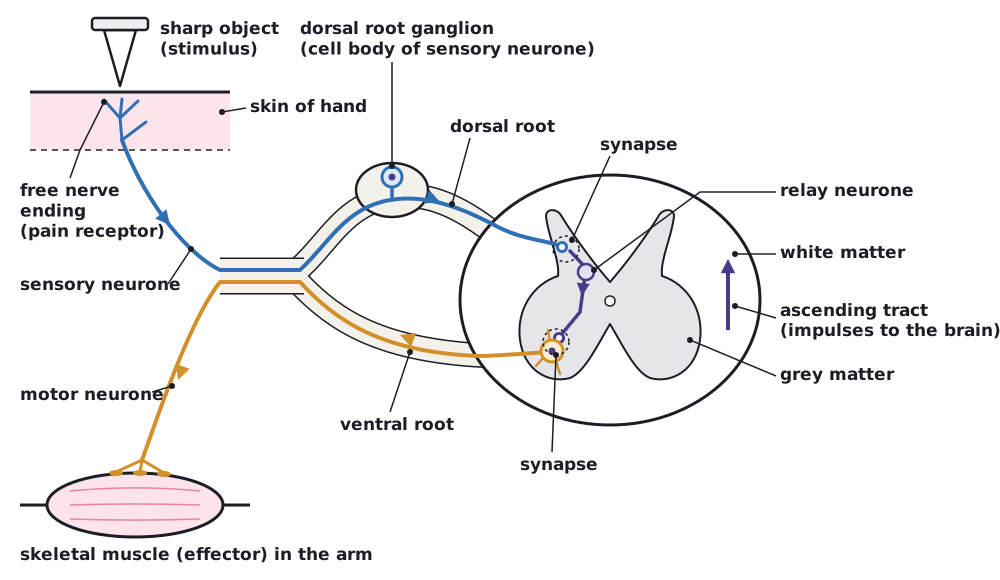
A spinal reflex arc is a rapid, automatic, protective response in which a receptor, sensory neurone, relay neurone in the grey matter of the spinal cord, motor neurone and effector are linked. White matter, made of myelinated axons, carries impulses up and down the cord to and from the brain.
A reflex is a rapid, automatic response to a stimulus that does not involve conscious thought. The pathway is a reflex arc. In a spinal reflex arc the neurones pass through the spinal cord, so the response does not wait for the brain. This makes it fast, which is protective: for example, the withdrawal of a hand from a hot object.
In cross-section the spinal cord has an inner, butterfly-shaped region of grey matter surrounded by white matter. Grey matter contains the cell bodies of relay and motor neurones and many synapses. White matter looks pale because it consists of the myelinated axons of neurones, which run up and down the cord carrying impulses to and from the brain. A fluid-filled central canal runs through the middle.
 (opens full size in a new tab)
- A receptor (for example a pain receptor in the skin) detects a stimulus and generates an impulse.
- The impulse passes along a sensory neurone, whose cell body lies in the dorsal root ganglion, into the spinal cord by the dorsal root.
- In the grey matter the sensory neurone synapses with a relay neurone.
- The relay neurone synapses with a motor neurone.
- The motor neurone carries the impulse out by the ventral root to an effector (a muscle), which contracts to withdraw the limb.
At the same time, relay neurones pass impulses up the white matter to the brain, so you become aware of the stimulus after the response has begun. The brain can also send impulses down the cord to override some reflexes.
Link structure to function in a reflex: few synapses and a short pathway mean a faster response, and the response is automatic so it protects the body before pain is felt.
Quick check
Where is the cell body of a sensory neurone found?
Show answer
In the dorsal root ganglion, just outside the spinal cord.
What is myelin made from?
Show answer
Many layers of the plasma membrane of Schwann cells, which are rich in lipid.
Name the two parts of the mammalian nervous system.
Show answer
The central nervous system (brain and spinal cord) and the peripheral nervous system.
What does the white matter of the spinal cord contain?
Show answer
Myelinated axons carrying impulses up and down the cord.
Written and checked against the Edexcel International A Level Biology (YBI11) specification · Updated October 2026