
Pigments, spectra and chromatographySpec 5.6, 5.7
In short
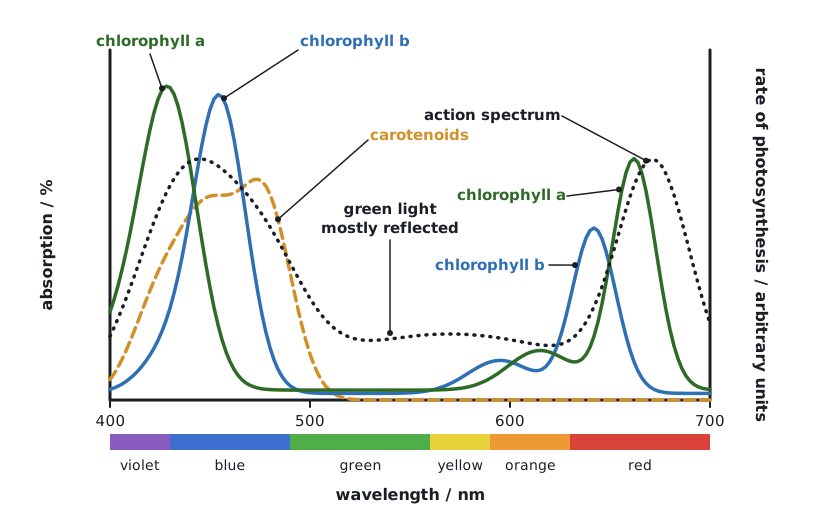
An absorption spectrum shows how much light of each wavelength a pigment absorbs. An action spectrum shows the rate of photosynthesis at each wavelength. Chloroplast pigments can be separated by chromatography because they differ in solubility in the solvent, and identified by their Rf values.
- Absorption spectrum
- A graph showing how much light of different wavelengths is absorbed by a pigment (or by a leaf extract).
- Action spectrum
- A graph showing the rate of photosynthesis (for example oxygen released or carbon dioxide taken up) at different wavelengths of light.
Chloroplasts contain a mixture of photosynthetic pigments. Chlorophyll a and chlorophyll b absorb mostly red and blue-violet light, and reflect green light. Carotenoids (for example carotene and xanthophyll) absorb mostly blue-violet and blue-green light. Different pigments absorbing different wavelengths mean that more of the available light is used.
The action spectrum has a similar shape to the combined absorption spectra of the pigments. This shows that the wavelengths that are absorbed are the ones used in photosynthesis. The action spectrum is not identical to the absorption spectrum, because some light absorbed by accessory pigments is passed on to chlorophyll a with some loss of efficiency, and not all absorbed light is used in photosynthesis.
 (opens full size in a new tab)
Do not say that an action spectrum shows how much light is absorbed. It shows the rate of photosynthesis.
Separating pigments by chromatography (5.7)
- Grind fresh leaves with a little propanone (or ethanol) and sand to extract the pigments.
- Draw a pencil line (the origin) about 2 cm from the bottom of a chromatography paper strip (or a thin-layer chromatography plate). Use pencil because ink would also dissolve in the solvent.
- Apply a small spot of extract on the line and let it dry. Repeat several times to build up a concentrated spot.
- Stand the paper in a container with a shallow layer of solvent (a mixture such as petroleum ether and propanone) below the origin line. Cover the container.
- When the solvent front is near the top, remove the paper and mark the solvent front at once with a pencil before it evaporates.
- Measure the distance from the origin to the centre of each pigment spot and from the origin to the solvent front.
The pigments separate because they have different solubilities in the solvent and different affinities for the paper (or plate). A pigment that is more soluble in the solvent, and sticks less strongly to the paper, travels further.
The Rf value has no units and is always less than 1. The same pigment gives the same Rf value in the same solvent and under the same conditions, so Rf values can be compared with published values to identify pigments. Carotene travels furthest (highest Rf), followed by xanthophyll, then chlorophyll a, then chlorophyll b (lowest Rf of the four).
Calculating an Rf value
A pigment spot is 5.4 cm from the origin. The solvent front is 7.2 cm from the origin. Calculate the Rf value of the pigment.
- Rf = distance moved by the pigment ÷ distance moved by the solvent front
- Rf = 5.4 ÷ 7.2
Answer: Rf = 0.75 (no units)
Measure to the centre of each spot, and measure both distances from the same origin line. Rf has no unit, and a value above 1 means a measuring slip.
If asked about risks or good practice in chromatography: handle propanone and other solvents in a well-ventilated area away from flames, wear eye protection, and keep the lid on the container so the atmosphere in the tank stays saturated with solvent vapour.
Written and checked against the Edexcel International A Level Biology (YBI11) specification · Updated October 2026