
Why many animals have a heart and circulationSpec 1.6
In short
Many animals have a heart and circulation because diffusion alone cannot meet the needs of large organisms. As size increases, the surface area to volume ratio falls and diffusion distances rise, while active animals have a high metabolic rate. Mass transport of blood, pumped under pressure by the heart, supplies cells quickly and removes waste.
Small organisms, such as single-celled ones, exchange substances by diffusion directly across their surface. Their surface area to volume ratio is large and the distance from the surface to any part of the cell is tiny, so diffusion is fast enough.
In a large animal this stops working, for three reasons.
- Surface area to volume ratio falls as size increases, so the body surface is too small to supply a large volume of cells.
- Diffusion distances to cells deep inside the body are long. Diffusion is only fast over very short distances, and the time taken rises sharply as the distance increases.
- A high metabolic rate (as in active, warm-blooded animals) means cells use oxygen and glucose, and produce carbon dioxide and wastes, faster than diffusion could move them.
Mass transport solves this problem. A liquid (blood) is moved in bulk, quickly, over long distances through vessels by the pressure generated by a pump (the heart). Blood carries oxygen and nutrients to cells and removes carbon dioxide and wastes. Continually moving blood also keeps concentration gradients steep at the exchange surfaces, which keeps diffusion going.
Mammals have a closed, double circulation. Blood stays inside vessels, and passes through the heart twice on each complete circuit: right side of the heart to the lungs, then back to the left side of the heart to be pumped to the rest of the body. Pumping blood to the lungs at lower pressure protects the delicate lung capillaries. Returning it to the heart means the pressure can be raised again before it goes to the body.
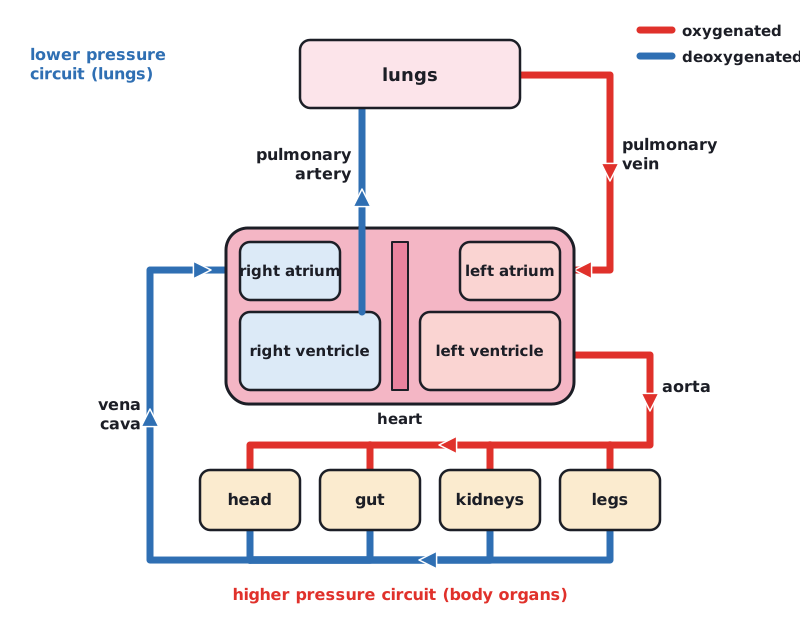 (opens full size in a new tab)
Surface area to volume ratio and size
A cube-shaped organism has sides of 1 cm. Another has sides of 4 cm. Calculate the surface area to volume ratio of each and comment.
- 1 cm cube: surface area = 6 × 1² = 6 cm²; volume = 1³ = 1 cm³; ratio = 6 : 1
- 4 cm cube: surface area = 6 × 4² = 96 cm²; volume = 4³ = 64 cm³; ratio = 96 ÷ 64 = 1.5 : 1
Answer: 6 : 1 and 1.5 : 1. The larger organism has a much smaller surface area to volume ratio, so diffusion across its surface cannot supply all its cells.
Surface area to volume ratio: for a cube of side L, surface area = 6L² and volume = L³. Write the ratio as surface area : volume, and give units for the areas and volumes you calculate.
Written and checked against the Edexcel International A Level Biology (YBI11) specification · Updated October 2026