
Selective reabsorption and the loop of HenleSpec 7.20
In short
In the proximal convoluted tubule, glucose, amino acids and ions are selectively reabsorbed by co-transport and active transport, followed by water by osmosis. The loop of Henle acts as a countercurrent multiplier: ions pumped out of the ascending limb create a low water potential in the medulla, so more water is reabsorbed from the filtrate.
The proximal convoluted tubule
The cells lining the proximal tubule have microvilli (a large surface area) and many mitochondria (to supply ATP for active transport). They carry out selective reabsorption:
- Sodium ions are actively transported out of the cell into the blood side by sodium–potassium pumps, lowering the sodium concentration in the cell.
- Sodium ions then move into the cell from the filtrate down their concentration gradient through co-transporter proteins, carrying glucose or amino acids with them (co-transport). Glucose and amino acids then pass into the blood by facilitated diffusion.
- All of the glucose and amino acids are normally reabsorbed, as well as much of the sodium and chloride ions.
- Water follows by osmosis, because the water potential of the cells and blood is now lower. Most of the filtrate (about 80%) is reabsorbed here, and some urea diffuses out.
The loop of Henle as a countercurrent multiplier
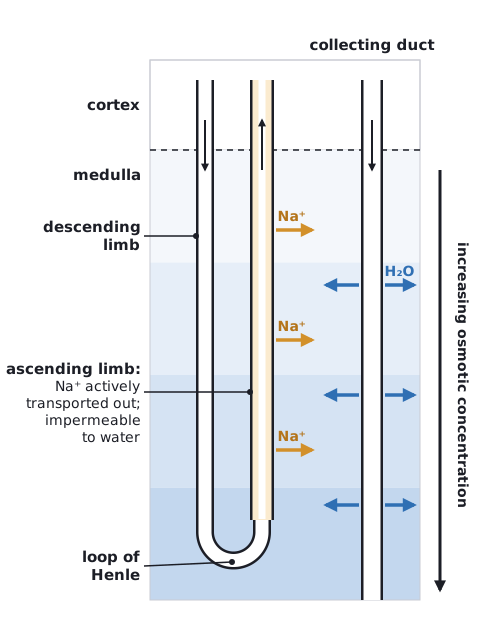
The loop creates a high concentration of solutes (a low water potential) in the tissue fluid of the medulla, which increases the reabsorption of water from the filtrate in the collecting duct. It does this by using a countercurrent multiplier mechanism: the fluid flows in opposite directions in the two limbs, and a small difference at each level is multiplied into a large gradient along the whole loop.
- In the ascending limb, which is impermeable to water, sodium and chloride ions are actively pumped out into the medulla. This lowers the water potential of the medulla tissue fluid.
- In the descending limb, which is permeable to water but not to ions, water leaves the filtrate by osmosis into the medulla. The filtrate becomes more concentrated as it descends, so it is most concentrated at the bottom of the loop.
- As the filtrate rises in the ascending limb, ions move out (they diffuse out from the lower part and are actively pumped out in the upper part), so the filtrate becomes more dilute again.
- The concentration gradient in the medulla is kept steep, with the lowest water potential deepest in the medulla.
- Blood capillaries (the vasa recta) carry away the reabsorbed water.
The filtrate then flows through the distal tubule and the collecting duct, which pass back down through the medulla. If the collecting duct is permeable to water, water moves out by osmosis down the water potential gradient, producing concentrated urine. Animals with long loops of Henle (such as desert mammals) have a steeper gradient and can produce a more concentrated urine.
The descending limb is permeable to water, while the ascending limb is not. Do not say that water is reabsorbed from the ascending limb.
 (opens full size in a new tab)
Written and checked against the Edexcel International A Level Biology (YBI11) specification · Updated October 2026