
SuccessionSpec 5.15
In short
Succession is the gradual change in the species of a community over time, from colonisation by pioneer species to a stable climax community. Pioneers change the abiotic conditions, making them less hostile for other species. Biodiversity and biomass rise as larger, more competitive species replace earlier ones, until a stable climax community forms.
Succession is the process by which an ecosystem changes over time, with one community of species replacing another. Primary succession starts on bare, newly formed land such as rock or sand dunes, where there is no soil. Secondary succession happens where soil is already present, for example after a forest fire or when farmland is abandoned.
- Colonisation: pioneer species such as lichens, mosses or algae arrive, often as wind-blown spores or seeds. They are adapted to tolerate harsh abiotic conditions, such as low nutrients and water availability, and can photosynthesise or fix nitrogen.
- Pioneers change the abiotic environment. They weather rock, trap dead material and, when they die and are decomposed, add organic matter and minerals, which form a thin soil that holds more water.
- The conditions become less hostile, so new species such as grasses and small herbs can germinate and grow. They outcompete the pioneers, which are replaced. Each community changes the conditions and allows the next to colonise (shrubs, then trees).
- As succession proceeds, soil depth, nutrients and water retention increase. Species diversity and biomass rise, and food webs become more complex.
- Eventually a stable climax community forms, in which the species are in balance with the abiotic environment (especially the climate) and no further net change in species occurs. The climax community is usually dominated by a few large, long-lived species, such as woodland trees in temperate climates.
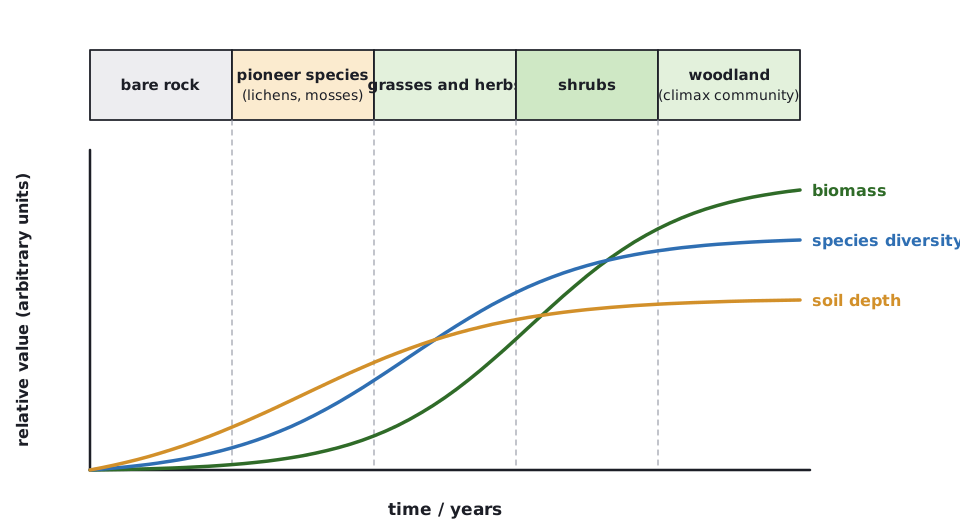 (opens full size in a new tab)
| Feature | Pioneer stage | Climax community |
|---|---|---|
| Species diversity | Low | High (but dominated by a few species) |
| Soil depth and nutrients | Thin soil or none; few nutrients | Deep, rich soil |
| Abiotic conditions | Harsh and variable | Stable, less extreme |
| Biomass | Low | High |
| Food webs | Simple | Complex |
| Size of dominant plants | Small | Large |
The key idea is that each stage changes the environment, making it more suitable for the next. Say what the species change (the abiotic conditions such as soil) and what that allows.
Quick check
Write the equation linking NPP, GPP and R.
Show answer
NPP = GPP − R.
Give two ways in which energy is lost between trophic levels.
Show answer
Respiration (heat), egestion, excretion, uneaten parts.
What is a niche?
Show answer
The role of a species in its habitat, including its interactions with biotic and abiotic factors.
Why are quadrats placed at random?
Show answer
To avoid bias in sampling.
What is a climax community?
Show answer
The stable community at the end of succession, in balance with the abiotic conditions.
Written and checked against the Edexcel International A Level Biology (YBI11) specification · Updated October 2026