
Core practical 18: amylase in germinating cereal grainsSpec 8.12
In short
In core practical 18, halves of germinating cereal grains are placed on starch agar. Amylase made in the grains digests the starch, so after flooding with iodine solution a clear zone forms around each half. The size of the clear zone shows how much amylase was produced, and the roles of the embryo and gibberellin can be tested.
Core practical 18: investigate the production of amylase in germinating cereal grains. Your teacher may use a variant of the method below, so check which apparatus and treatments you used.
The aim is to show that the germinating grain produces amylase, and that the embryo (through gibberellin) is needed to switch on its production.
- Prepare agar plates containing starch, using sterile technique.
- Surface-sterilise germinating barley grains (for example by soaking them briefly in dilute bleach and rinsing in sterile water), because bacteria and fungi on the grains also make amylase.
- Cut the grains in half across the middle with a scalpel on a tile. One half contains the embryo, the other does not.
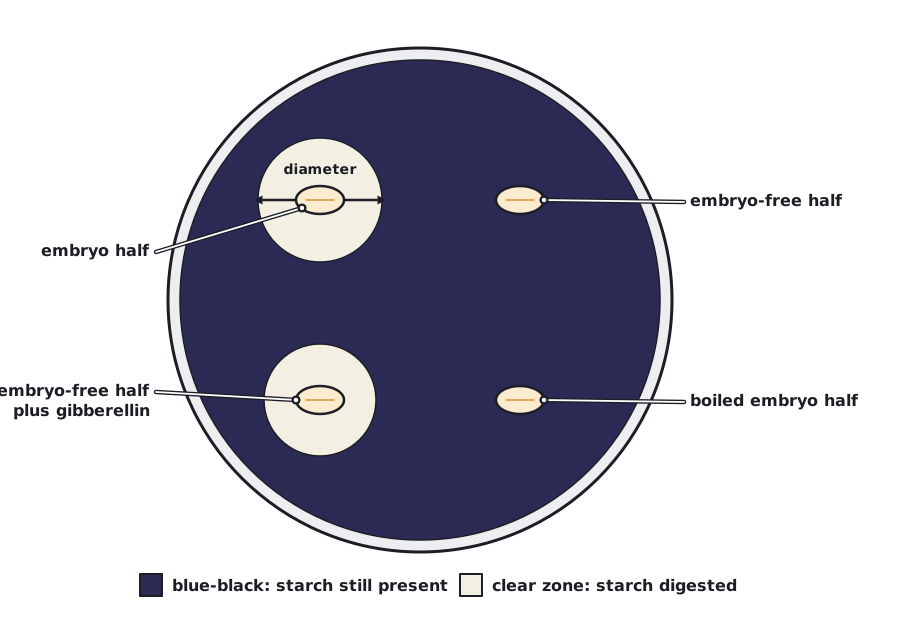
- Place halves cut side down on the agar. For example: embryo halves; embryo-free halves; embryo-free halves with gibberellin solution; boiled embryo halves as a control.
- Incubate at a constant temperature (for example 25 °C) for 24 to 48 hours.
- Remove the grain halves and flood the plates with iodine in potassium iodide solution for a minute, then pour the excess off.
- Starch turns blue-black. A clear zone where starch has been digested by amylase appears around each half. Measure the diameter of each clear zone.
| Type | Detail |
|---|---|
| Independent variable | Treatment of the grain half (embryo present or absent, gibberellin added or not) |
| Dependent variable | Diameter, or area, of the clear zone / mm or mm² |
| Controlled variables | Age, mass and type of grain; concentration and volume of starch agar; temperature; incubation time; volume and concentration of gibberellin and iodine |
| Controls | Boiled embryo halves (enzyme and gibberellin denatured) and agar with no grain, showing that the clear zone is caused by living tissue producing amylase |
| Safety | Scalpel: cut away from the body on a tile. Iodine solution stains and irritates: wear eye protection and wash spills. Sterile technique: tape the lids during incubation, open plates only briefly to remove the grains and add iodine, dispose of plates safely (for example by autoclaving) and wash hands. |
To process results, measure the diameter of each clear zone in two directions at right angles and take the mean. Calculate the area from πr² and compare the mean area for each treatment. Repeat each treatment several times to identify anomalies and calculate a mean. Because a clear zone is only a rough measure of the amount of amylase, results are semi-quantitative.
Area of a clear zone
A clear zone has a mean diameter of 14 mm. Calculate its area.
- radius = 14 ÷ 2 = 7 mm
- area = πr² = π × 7² = π × 49
Answer: 154 mm² (to 3 significant figures)
Area of a circle = πr². Halve the diameter first, then square the radius, and give units (mm²).
 (opens full size in a new tab)
Quick check
Which wavelength of light converts Pr to Pfr?
Show answer
Red light (about 660 nm).
Which form of phytochrome is active?
Show answer
Pfr.
How does auxin make cells elongate?
Show answer
It increases proton pumping into the cell wall; the acidic wall becomes more extensible and the cell takes in water.
Where is amylase made in a germinating cereal grain?
Show answer
In the aleurone layer, under the control of gibberellin from the embryo.
Written and checked against the Edexcel International A Level Biology (YBI11) specification · Updated October 2026