
Gross and net primary productivitySpec 5.9
In short
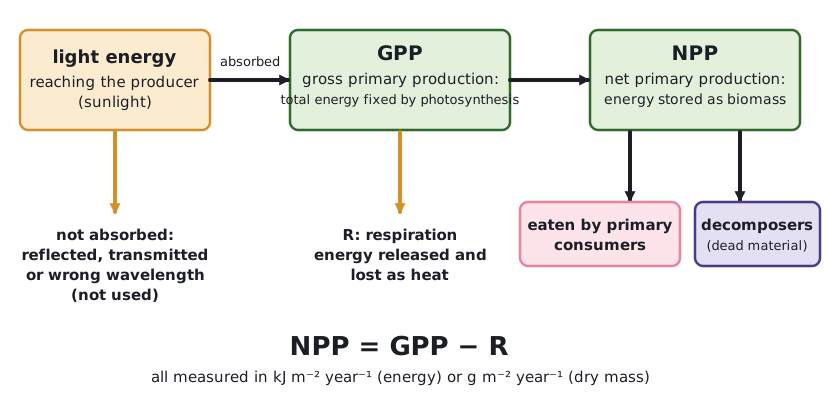
Gross primary productivity (GPP) is the rate at which plants fix chemical energy by photosynthesis. Net primary productivity (NPP) is what remains after the plants’ own respiration (R) is subtracted: NPP = GPP − R. NPP is the energy available to primary consumers and decomposers, and is stored as new biomass.
- Gross primary productivity (GPP)
- The total chemical energy fixed by photosynthesis in a given area in a given time (for example kJ m⁻² year⁻¹).
- Net primary productivity (NPP)
- The chemical energy remaining in plant biomass after the energy lost in respiration has been taken away. It is the energy available to the next trophic level.
Plants use some of the sugars they make in respiration, to release energy for growth, active transport and other processes. This energy is eventually lost as heat. Only the remainder is stored in new plant material (growth), which is the biomass that can be eaten by herbivores or decomposed. Productivity is measured as a rate, for example kJ m⁻² year⁻¹ for energy or g m⁻² year⁻¹ for dry mass of biomass.
 (opens full size in a new tab)
Calculating NPP
A field of grass fixes 12 500 kJ m⁻² year⁻¹ of energy by photosynthesis. The grass loses 4 100 kJ m⁻² year⁻¹ in respiration. Calculate the net primary productivity and express it as a percentage of GPP.
- NPP = GPP − R
- NPP = 12 500 − 4 100 = 8 400 kJ m⁻² year⁻¹
- Percentage = 8 400 ÷ 12 500 × 100
Answer: NPP = 8 400 kJ m⁻² year⁻¹ (67.2 % of GPP)
You may be given any two of GPP, R and NPP and asked for the third. Rearrange the equation first and give the unit (kJ m⁻² year⁻¹ or g m⁻² year⁻¹).
Do not say that GPP is the energy absorbed from the Sun. Most light is not absorbed, and only a small percentage of the light energy that reaches the leaf is fixed.
Written and checked against the Edexcel International A Level Biology (YBI11) specification · Updated October 2026