
Aerobic respiration: the overall reactionSpec 7.1
In short
Aerobic respiration splits a respiratory substrate such as glucose, releasing carbon dioxide as a waste product and reuniting the hydrogen removed with atmospheric oxygen to form water, releasing large amounts of energy. It is a stepped process: each step is controlled and catalysed by a specific intracellular enzyme.
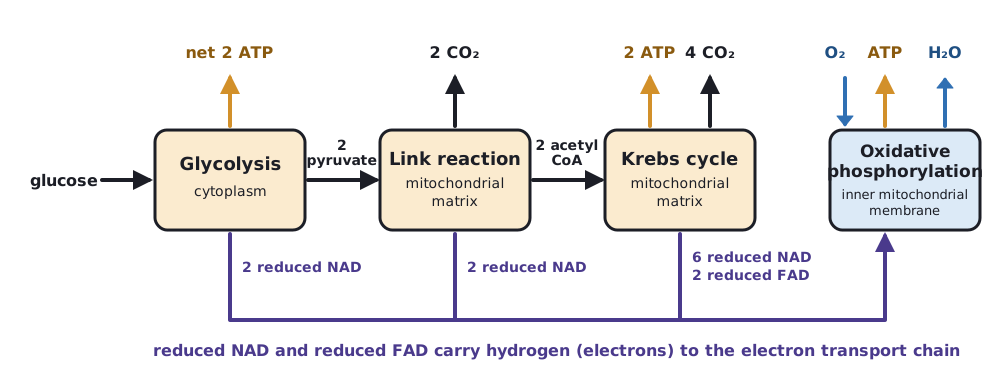
Respiration transfers the chemical energy in a respiratory substrate (usually glucose) to ATP, the energy currency of the cell. Aerobic respiration needs oxygen. The overall reaction is shown below.
Two things happen to the substrate. Its carbon atoms are removed as carbon dioxide, which is a waste product (decarboxylation). Its hydrogen atoms are removed and picked up by the hydrogen carriers NAD and FAD, which become reduced NAD and reduced FAD (dehydrogenation). At the end of the process the hydrogen is reunited with atmospheric oxygen to make water, and this releases a large amount of energy that is used to make ATP.
- Respiratory substrate
- An organic molecule, such as glucose, that is oxidised in respiration to release energy.
- Decarboxylation
- Removal of carbon dioxide from a substrate molecule.
- Dehydrogenation
- Removal of hydrogen atoms from a substrate molecule, usually by an enzyme with NAD or FAD as the hydrogen acceptor.
Why respiration is a stepped process
Respiration is not one reaction but a series of small steps. Each step is controlled and catalysed by a specific intracellular enzyme, so the names of the individual enzymes are not required.
- Energy is released in small, manageable amounts rather than one large burst.
- More of the energy can be captured in ATP, and less is lost as heat that could damage the cell.
- Each step can be controlled separately, so the cell can speed up or slow down respiration to match its needs.
- Intermediate compounds can be diverted into other metabolic pathways.
The carbon dioxide does not come from the oxygen you breathe in. It comes from the carbon in the substrate, removed by decarboxylation. Oxygen only accepts hydrogen at the end, forming water.
 (opens full size in a new tab)
Written and checked against the Edexcel International A Level Biology (YBI11) specification · Updated October 2026