
The light-dependent reactionsSpec 5.3
In short
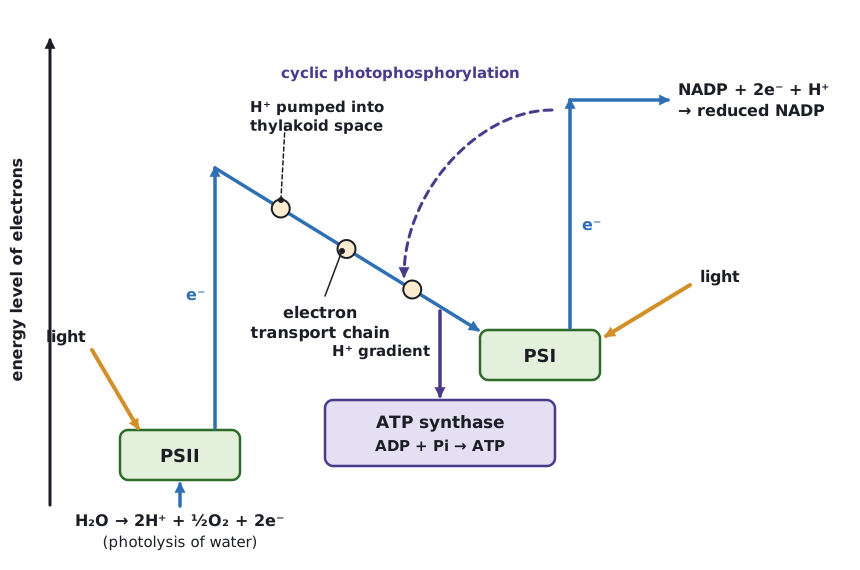
The light-dependent reactions take place on the thylakoid membranes. Light energy excites electrons in chlorophyll, and these electrons pass along an electron transport chain, which makes ATP. In non-cyclic photophosphorylation, NADP is also reduced and water is split by photolysis, releasing oxygen. Cyclic photophosphorylation makes ATP only.
The light-dependent reactions take place on the thylakoid membranes of the chloroplast. Chlorophyll and other pigments are arranged in two groups called photosystems: photosystem I (PSI) and photosystem II (PSII). Each photosystem traps light energy and passes it to a reaction centre containing chlorophyll a.
How light energy is trapped
When a photon of light hits chlorophyll, an electron in the chlorophyll is raised to a higher energy level. The electron is said to be excited. It leaves the chlorophyll molecule and is passed to an electron carrier. The chlorophyll has been oxidised (it has lost an electron).
Non-cyclic photophosphorylation
- Light energy excites two electrons in chlorophyll in photosystem II. They leave the chlorophyll and are taken up by the first electron carrier in the electron transport chain.
- The electrons pass down the electron transport chain from carrier to carrier, losing energy at each step in a series of redox reactions.
- The energy lost is used to pump protons (H⁺) from the stroma into the thylakoid space. This builds up a proton gradient across the thylakoid membrane.
- Protons flow back down their concentration gradient into the stroma through ATP synthase. This is chemiosmosis. The flow drives the synthesis of ATP from ADP and Pi (photophosphorylation).
- Light also excites electrons in photosystem I. These electrons are passed to NADP, which also accepts a proton (H⁺) from the stroma, and is reduced to reduced NADP.
- The electrons lost from photosystem II are replaced by electrons from water. The enzyme-catalysed photolysis of water splits it: 2H₂O → 4H⁺ + 4e⁻ + O₂. The electrons replace those lost from chlorophyll. The H⁺ ions contribute to the proton gradient and are used to reduce NADP. The oxygen is a waste product, and diffuses out of the leaf or is used in respiration.
Because electrons flow in one direction, from water through the two photosystems to NADP, this is called non-cyclic photophosphorylation. Its products are ATP, reduced NADP and oxygen.
Cyclic photophosphorylation
In cyclic photophosphorylation only photosystem I is used. Excited electrons leave chlorophyll, pass along an electron transport chain and return to the same chlorophyll molecule. Energy lost along the chain is used to make ATP by chemiosmosis. No NADP is reduced, no water is split and no oxygen is made. The electrons are recycled, so no replacement electrons are needed.
| Feature | Non-cyclic | Cyclic |
|---|---|---|
| Photosystems used | Photosystem II and I | Photosystem I only |
| Source of electrons | Water (photolysis) | The same chlorophyll (electrons return) |
| ATP made | Yes | Yes |
| Reduced NADP made | Yes | No |
| Oxygen made | Yes | No |
 (opens full size in a new tab)
Photolysis is not the splitting of carbon dioxide. Oxygen released in photosynthesis comes from water.
Written and checked against the Edexcel International A Level Biology (YBI11) specification · Updated October 2026