
Muscles, tendons, the skeleton and ligamentsSpec 7.9
In short
Movement happens when skeletal muscles contract and pull on bones, which act as levers at joints. Tendons attach muscle to bone and ligaments attach bone to bone. Muscles can only pull, so they work in antagonistic pairs, such as the flexor and extensor muscles: one contracts while the other relaxes.
Skeletal muscles are attached to bones by tendons. Tendons are strong, inelastic bands of collagen, so the force of the muscle contracting is transmitted directly to the bone without being lost by stretching. Ligaments join bone to bone at a joint. They are strong and slightly elastic, and they hold the bones in place and stabilise the joint. The skeleton provides rigid levers, and the joint acts as the pivot.
A muscle can only pull when it contracts. It cannot push. To move a joint in both directions, muscles work in antagonistic pairs: when one muscle of the pair contracts, the other relaxes and is stretched.
| Feature | Biceps | Triceps |
|---|---|---|
| Type of muscle | Flexor | Extensor |
| Action when it contracts | Bends (flexes) the elbow, decreasing the angle | Straightens (extends) the elbow, increasing the angle |
| Attached to | Radius (by a tendon) | Ulna (by a tendon) |
| State while the other contracts | Relaxes when the triceps contracts | Relaxes when the biceps contracts |
A flexor is a muscle whose contraction bends a joint; an extensor is a muscle whose contraction straightens a joint. Another example is the hamstring (flexor of the knee) and quadriceps (extensor of the knee).
Do not say that the relaxed muscle 'pushes'. It is the contracting muscle that pulls, and the relaxed antagonist is stretched. Tendons join muscle to bone; ligaments join bone to bone.
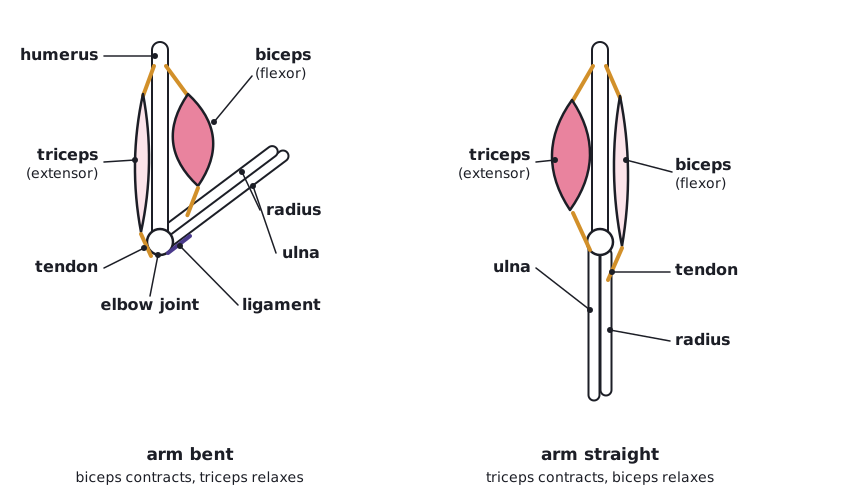 (opens full size in a new tab)
Written and checked against the Edexcel International A Level Biology (YBI11) specification · Updated October 2026