
Core practical 9: antimicrobial properties of plants and aseptic techniqueSpec 4.12
In short
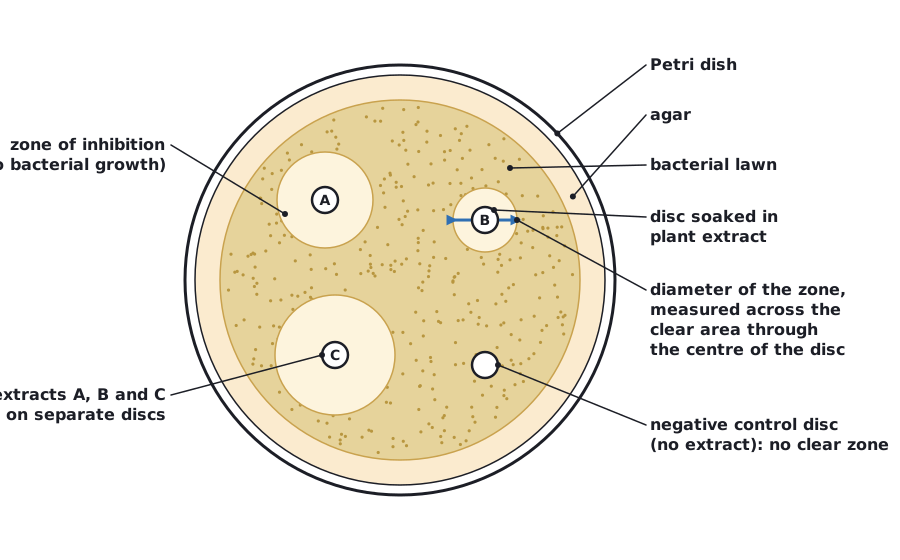
Antimicrobial properties of plants are investigated by spreading bacteria on agar, adding discs soaked in plant extracts and incubating. A clear zone of inhibition around a disc shows that the extract prevents growth. Aseptic technique prevents contamination of the culture and protects the worker, and controls show that the effect is due to the extract.
Core practical 9: investigate the antimicrobial properties of plants, including aseptic techniques for the safe handling of bacteria.
Aseptic technique
Aseptic technique prevents unwanted microorganisms contaminating the culture and prevents the bacteria escaping into the environment or infecting the worker.
- Disinfect the bench before and after work, and wash hands.
- Work near a lit Bunsen burner, where rising hot air carries microorganisms away from the work area.
- Sterilise inoculating loops by heating in a flame until red hot, then let them cool before touching the culture.
- Flame the neck of bottles after opening and before closing, hold lids rather than put them down, and lift the lid of a Petri dish only as far as needed.
- Use sterile Petri dishes, agar and spreaders, and keep dishes closed when not in use.
- Seal the lid with only two or four small pieces of tape, never fully around, so oxygen can enter and anaerobic pathogens are not encouraged. Incubate upside down, so condensation does not drip on the agar.
- Do not open dishes after incubation. Sterilise all equipment and cultures in an autoclave afterwards.
Method
- Prepare plant extracts, for example by crushing fresh leaves or cloves in a mortar with a measured volume of solvent and filtering. Keep the same mass of plant material and volume of solvent for each plant, and make a dilution series if concentration is being tested.
- Using aseptic technique, spread a standard volume of a non-pathogenic bacterial culture evenly over the surface of nutrient agar in a Petri dish to make a bacterial lawn.
- Place sterile filter paper discs, soaked for the same time in each plant extract, onto the lawn with sterile forceps. Include a negative control disc soaked only in the solvent and, if available, a positive control disc with a known antibiotic.
- Tape, invert and incubate the dishes at 25 °C for 24 to 48 hours.
- Measure the diameter of the clear zone around each disc (zone of inhibition) in two directions at right angles and calculate a mean diameter. Calculate the area of the zone (area = πr²).
| Type | Detail |
|---|---|
| Independent | Type of plant extract (or concentration of the extract) |
| Dependent | Diameter or area of the clear zone of inhibition |
| Control (kept constant) | Volume of bacteria spread; type of bacteria; agar depth and type; size of disc; volume and concentration of extract; incubation temperature and time |
| Control experiment | Disc soaked in solvent only (negative control) shows that the solvent does not prevent growth; a disc with antibiotic (positive control) shows that bacteria can be inhibited |
 (opens full size in a new tab)
Comparing zones of inhibition
A clear zone of diameter 14 mm formed around a disc soaked in garlic extract. Calculate the area of the zone of inhibition.
- radius = 14 ÷ 2 = 7 mm
- area = πr² = π × 7²
Answer: 154 mm² (to 3 significant figures)
The area of the clear zone (πr²) is often used because it describes the whole region where growth was inhibited; ranking extracts by diameter gives the same order. If asked for the area of inhibition only, subtract the area of the disc.
A zone of inhibition does not show that bacteria are killed, only that growth is stopped. A negative control is needed to show that the effect is due to the extract and not the solvent.
Written and checked against the Edexcel International A Level Biology (YBI11) specification · Updated October 2026