
Core practical 10: factors affecting the rate of photosynthesisSpec 5.8
In short
Core practical 10 investigates how light intensity, wavelength, temperature and carbon dioxide availability affect the rate of photosynthesis in an aquatic plant such as Cabomba or Elodea. The rate is found by counting bubbles of oxygen or measuring the volume of gas released per unit time, changing one factor at a time.
Core practical 10: investigate the effects of light intensity, light wavelength, temperature and availability of carbon dioxide on the rate of photosynthesis using a suitable aquatic plant.
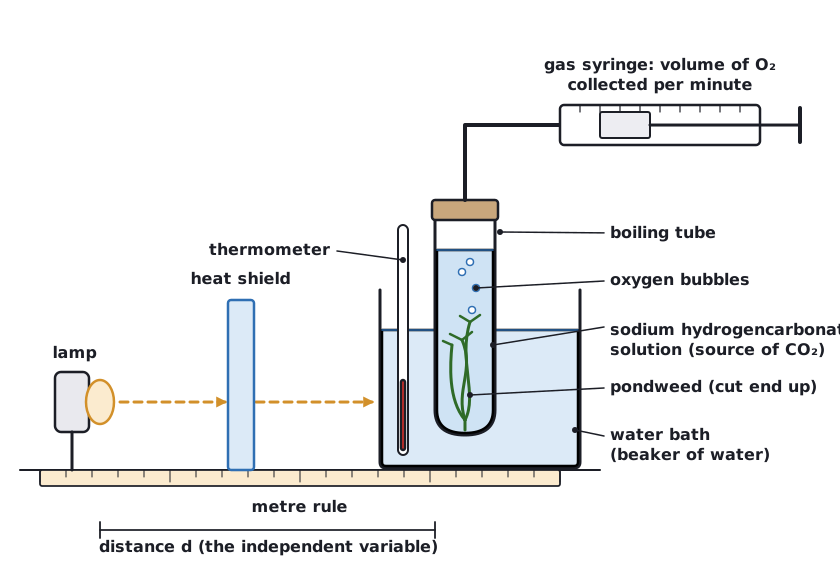
A piece of aquatic plant (for example Cabomba or Elodea) is cut at the stem under water and placed in a boiling tube or beaker with the cut end upwards. Oxygen released in photosynthesis forms bubbles at the cut end. The rate of photosynthesis is estimated from the number of bubbles per minute, or more accurately from the volume of gas collected in a capillary tube or gas syringe in a set time.
| Factor (independent variable) | How it is varied | What must be controlled |
|---|---|---|
| Light intensity | Move a lamp to different measured distances from the plant (intensity is proportional to 1 ÷ distance²) | Temperature (place a heat shield, such as a beaker of water, between lamp and plant), carbon dioxide concentration, plant mass, wavelength |
| Light wavelength | Use coloured filters, or LEDs of different colours, at a fixed distance | Light intensity (check it with a light meter), temperature, carbon dioxide concentration |
| Temperature | Use a water bath at several set temperatures (for example 10 to 40 °C), checked with a thermometer | Light intensity, carbon dioxide concentration, plant mass; allow the plant to equilibrate before counting |
| Carbon dioxide availability | Use sodium hydrogencarbonate solutions of different concentrations (for example 0.00 to 0.10 mol dm⁻³), which release carbon dioxide | Light intensity, temperature, plant mass, volume of solution |
 (opens full size in a new tab)
Method and good practice
- Leave the plant under the lamp for a few minutes to adjust to each new condition (equilibrate), then count bubbles or measure gas volume for a fixed time such as 2 or 5 minutes.
- Repeat at least three times at each value of the independent variable and calculate a mean, ignoring anomalous results.
- Use the same plant (or pieces cut to the same length and mass) throughout, and the same volume of solution in the tube.
- A control with no plant, or with a plant in the dark, shows that bubbles come from the plant’s photosynthesis.
Processing results
Rate = volume of oxygen collected ÷ time, in cm³ min⁻¹. Plot rate against the independent variable. Light intensity can be plotted against 1 ÷ distance², because intensity is inversely proportional to the square of the distance from a point source. A graph that levels off shows that another factor has become limiting.
Calculating a rate and a mean
In three trials at 20 cm from the lamp, a plant gave off 0.9, 1.0 and 1.1 cm³ of oxygen in 5 minutes. Calculate the mean rate of photosynthesis in cm³ min⁻¹.
- Mean volume = (0.9 + 1.0 + 1.1) ÷ 3 = 1.0 cm³
- Rate = volume ÷ time = 1.0 ÷ 5
Answer: 0.20 cm³ min⁻¹
Quote the unit of rate (cm³ min⁻¹), and say how many readings the mean was calculated from.
Risks: the lamp and mains electricity are used near water, so keep the socket and lamp away from spills. The lamp can get hot; allow it to cool before moving it. Wash hands after handling plants and pond water.
Light, temperature and carbon dioxide can each be limiting. In an exam, say which factor is limiting at the point where a graph levels off, and why the other factors are not.
Quick check
Where does the oxygen released in photosynthesis come from?
Show answer
From the photolysis of water.
Name the enzyme that catalyses the fixation of carbon dioxide by RuBP.
Show answer
Rubisco (ribulose bisphosphate carboxylase-oxygenase).
Which stage of photosynthesis makes reduced NADP?
Show answer
The light-dependent reactions (non-cyclic photophosphorylation).
What is the formula for the Rf value?
Show answer
Distance moved by the pigment ÷ distance moved by the solvent front.
Written and checked against the Edexcel International A Level Biology (YBI11) specification · Updated October 2026