
The structure and properties of cell membranesSpec 2.2
In short
A cell membrane is a phospholipid bilayer, about 7 nm thick, with hydrophilic heads facing outwards and hydrophobic tails facing inwards. Proteins, cholesterol, glycoproteins and glycolipids are embedded in it. The membrane is partially permeable and controls which substances enter and leave the cell.
All cells are surrounded by a cell-surface membrane, and eukaryotic cells also have membranes around organelles. They all share the same basic structure, which is described by the fluid mosaic model.
The phospholipid bilayer
A phospholipid has a hydrophilic (water-loving) phosphate head and two hydrophobic (water-hating) fatty acid tails. In water, phospholipids form a bilayer: the heads face outwards towards the water inside and outside the cell, and the tails face inwards, away from water. The bilayer is about 7 nm thick. Phospholipids are not fixed in place, so the layer is fluid: they move sideways within their own layer.
Other components
| Component | Position | Role |
|---|---|---|
| Phospholipids | Form the bilayer | Form a barrier to most water-soluble substances; the hydrophobic centre blocks ions and large polar molecules. |
| Cholesterol | Between the phospholipid tails (animal cells) | Regulates fluidity: it stops the membrane becoming too fluid at higher temperatures and stops the tails packing too closely at lower temperatures. Also makes the membrane more stable. |
| Intrinsic (integral) proteins | Span the whole bilayer | Form channels and carriers for transport; some are enzymes or receptors. |
| Extrinsic (peripheral) proteins | On one surface only | Act as enzymes, receptors or recognition sites, or link to the cell's internal framework. |
| Glycoproteins and glycolipids | On the outer surface, with carbohydrate chains | Act as receptors for hormones and other signals, and as cell recognition sites (antigens). |
Properties of the membrane
- Partially permeable: small non-polar molecules such as oxygen and carbon dioxide dissolve in the lipid and pass through the bilayer. Water also crosses, in small amounts, by diffusing between phospholipids. Ions and large polar molecules cannot cross the hydrophobic core and need channel or carrier proteins.
- Fluid and flexible: the membrane can change shape and fuse with other membranes (endocytosis and exocytosis).
- Separates the cell from its surroundings and divides the cell into compartments, so that different conditions can be kept in different places.
- Contains receptors and recognition sites, so cells can respond to signals and recognise one another.
Use the word 'hydrophobic' for the tails and 'hydrophilic' for the heads, and say where they face. Use these scientific terms rather than 'water-hating' and 'water-loving' alone.
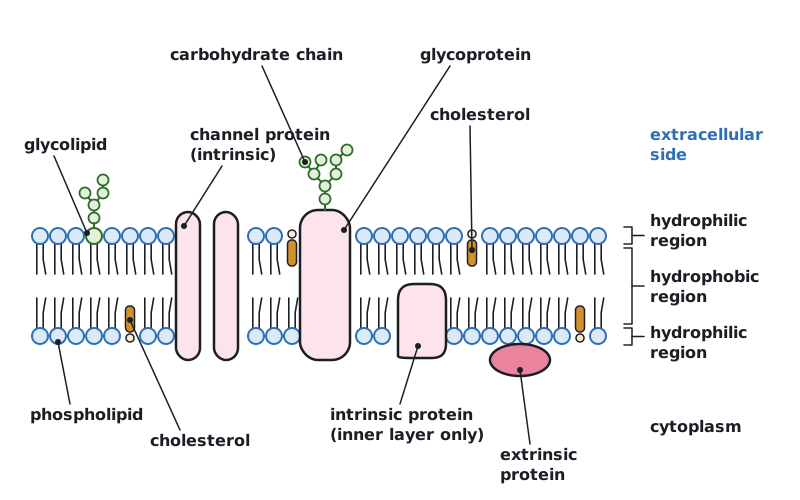 (opens full size in a new tab)
Written and checked against the Edexcel International A Level Biology (YBI11) specification · Updated October 2026