
Glycolysis

Respiration, Muscles and the Internal Environment · Stages of respiration · note 2 of 5

Spec 7.2
A Level only (what this means)A Level only: only in the full A Level, not the AS Level. AS Level students can skip it. What the labels mean
Download all Stages of respiration notes (PDF)Download all notes (PDF)7 pages

GlycolysisSpec 7.2

In short

Glycolysis is the first stage of both aerobic and anaerobic respiration and takes place in the cytoplasm. A hexose is phosphorylated using ATP, split into two triose phosphates and oxidised to two pyruvate, making a net gain of two ATP by substrate-level phosphorylation and two reduced NAD.

Glycolysis happens in the cytoplasm and does not need oxygen. It is the first stage of both aerobic and anaerobic respiration. Details of the intermediate stages and compounds are not required.

  1. Phosphorylation: two ATP molecules each donate a phosphate to the hexose (glucose), making hexose bisphosphate. This makes the sugar more reactive and traps it in the cell.
  2. Lysis: the hexose bisphosphate splits into two molecules of triose phosphate (3C).
  3. Oxidation: each triose phosphate is dehydrogenated. The hydrogen is accepted by NAD, forming reduced NAD.
  4. ATP formation: four ATP are made in total by substrate-level phosphorylation, and each triose phosphate is converted to a molecule of pyruvate (3C).
net yield per glucose = 2 ATP (4 made − 2 used) + 2 reduced NAD + 2 pyruvate
Substrate-level phosphorylation
Formation of ATP by the direct transfer of a phosphate group from a substrate molecule to ADP, without the electron transport chain.
Pyruvate
The 3C product of glycolysis. It enters the mitochondrion in aerobic respiration or is converted to lactate in anaerobic respiration in animals.
Exam tip:

Always say net gain of 2 ATP. Four ATP are made, but two were used at the start. Marks are lost for writing 4 ATP.
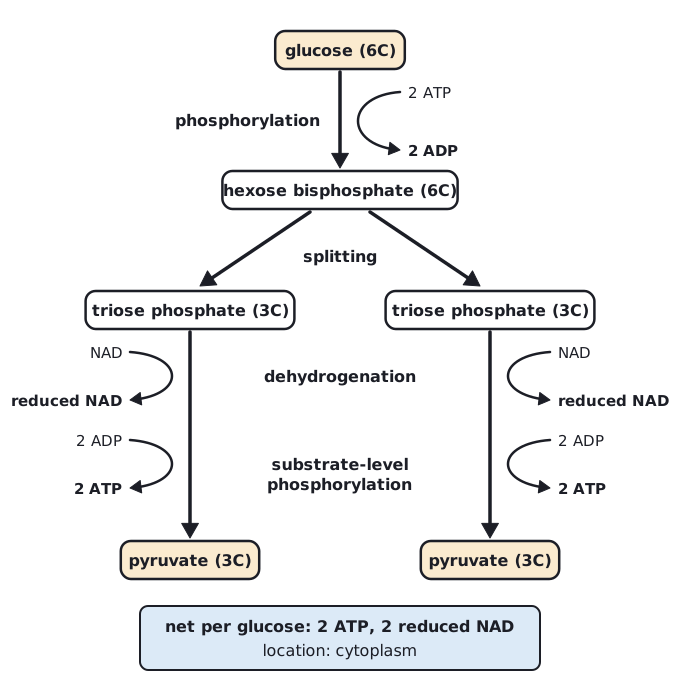
Glycolysis: glucose (6C) is phosphorylated using 2 ATP to hexose bisphosphate, split into two triose phosphates, which are dehydrogenated (NAD to reduced NAD) and make ATP by substrate-level phosphorylation to give two pyruvate; net 2 ATP and 2 reduced NAD. (opens full size in a new tab)
Glycolysis in the cytoplasm: two ATP are used, four are made, so the net gain is 2 ATP.

Written and checked against the Edexcel International A Level Biology (YBI11) specification · Updated October 2026

Frequently asked questions

What are the stages of aerobic respiration in order?

The stages are glycolysis in the cytoplasm, the link reaction and the Krebs cycle in the mitochondrial matrix, and oxidative phosphorylation on the inner mitochondrial membrane. Glucose is split, carbon is lost as carbon dioxide, hydrogen is carried by reduced NAD and reduced FAD, and ATP is made.

Where does the Krebs cycle take place?

The Krebs cycle takes place in the matrix of the mitochondrion. The link reaction also happens in the matrix, whereas glycolysis happens in the cytoplasm. Oxidative phosphorylation takes place on the inner mitochondrial membrane, which is folded into cristae to give a large surface area.

What is chemiosmosis in respiration?

Chemiosmosis is the movement of protons down their concentration gradient through ATP synthase. The electron transport chain pumps protons from the matrix into the intermembrane space. When they flow back through ATP synthase, the energy released is used to join ADP and inorganic phosphate to make ATP.

All 4 questions on Stages of respiration