
Gas exchange surfaces and Fick's lawSpec 2.1
In short
A gas exchange surface lets gases diffuse quickly because it has a large surface area to volume ratio, is very thin and keeps a steep concentration gradient. Fick's law states that the rate of diffusion is proportional to surface area multiplied by concentration difference, divided by the thickness of the exchange surface.
Every living organism must exchange gases with its environment: oxygen in and carbon dioxide out for aerobic respiration, and the reverse in photosynthesis. The gases cross a gas exchange surface by diffusion, so the surface has to be built to make diffusion fast.
A small, single-celled organism has a very large surface area to volume ratio, so diffusion across its outer surface is enough. A large organism has a much smaller surface area to volume ratio, so it needs a specialised exchange surface (such as the lungs of a mammal) and a transport system.
Properties of a good gas exchange surface
| Property | Effect on diffusion |
|---|---|
| Large surface area to volume ratio | More area for molecules to cross at the same time, so more gas is exchanged each second relative to the volume of the organism that needs it. |
| Thin surface (short diffusion distance) | Molecules have only a short distance to travel, so each crosses more quickly. Exchange surfaces are often one cell thick. |
| Large difference in concentration (steep concentration gradient) | Diffusion is the net movement down a concentration gradient. The steeper the gradient, the faster the net movement. The gradient is kept steep by removing gas on one side (blood flow) and bringing fresh supplies to the other (ventilation). |
Fick's law of diffusion
Fick's law links the rate of diffusion to all three properties at once.
- Doubling the surface area doubles the rate (all else equal).
- Doubling the concentration difference doubles the rate.
- Doubling the thickness of the surface halves the rate.
Using Fick's law to compare two surfaces
Surface A has an area of 50 mm², a concentration difference of 12 arbitrary units and a thickness of 0.5 µm. Surface B has the same area and concentration difference but is 2.0 µm thick. Calculate the relative rate of diffusion across each and state how many times faster diffusion is across A.
- Relative rate = (area × concentration difference) ÷ thickness.
- A: (50 × 12) ÷ 0.5 = 600 ÷ 0.5 = 1200 (arbitrary units).
- B: (50 × 12) ÷ 2.0 = 600 ÷ 2.0 = 300 (arbitrary units).
- Compare: 1200 ÷ 300 = 4.
Answer: A: 1200, B: 300. Diffusion is 4 times faster across A, because A is one quarter as thick.
Fick's law questions give you numbers and ask for a rate or a comparison. Use the same units for both surfaces, show the substitution, and give the answer in the units asked for or as a ratio.
Do not write 'large surface area' on its own for an organism. Edexcel asks about surface area to volume ratio, and about thin surfaces and concentration gradients as three separate marking points.
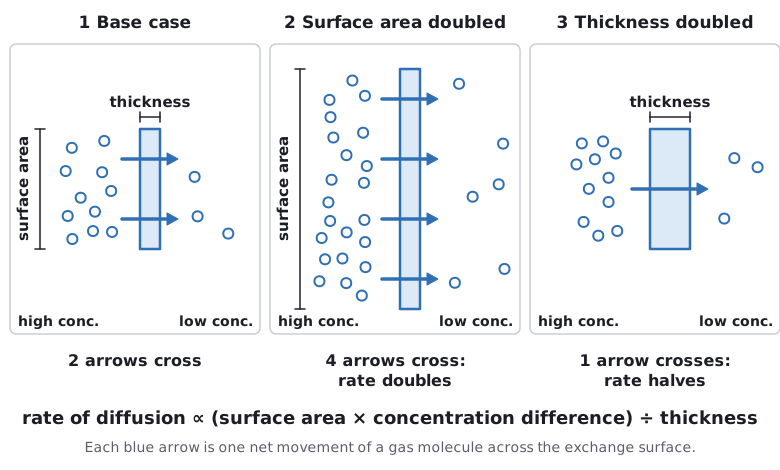 (opens full size in a new tab)
Written and checked against the Edexcel International A Level Biology (YBI11) specification · Updated October 2026