
Measuring the growth of microorganismsSpec 6.2
In short
The growth of a microbial population can be measured by counting cells directly, by dilution plating to count viable colonies, by finding the mass of cells, or by measuring the turbidity of a liquid culture with a colorimeter. Methods differ in whether they distinguish living from dead cells.
Growth of a population of microorganisms is an increase in the number of cells (or in their total mass). Four methods are named in the specification.
Cell counts
A sample of the culture is placed on a haemocytometer (a slide with a grid etched on it that holds a known small volume) and the cells in a number of squares are counted under a microscope. The mean count per square is scaled up to give cells per cm³. A total cell count includes dead cells as well as living cells. A stain such as methylene blue, which living yeast cells decolorise but dead cells do not, can be used to count only living cells.
Dilution plating (viable count)
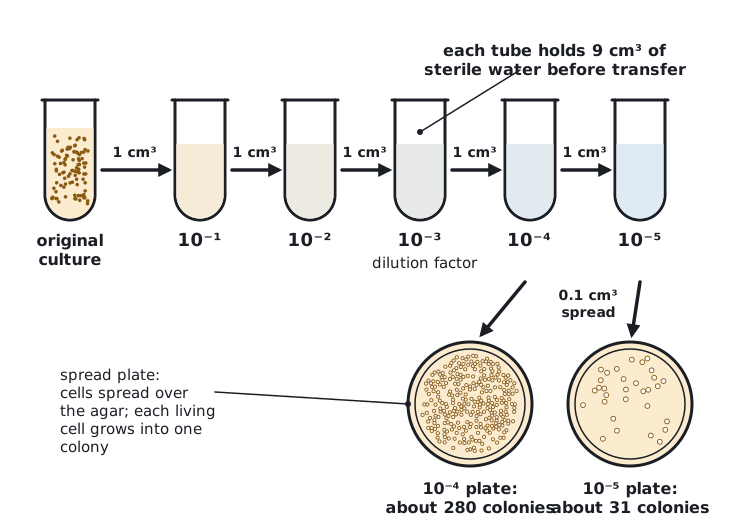
A serial dilution of the culture is made, for example by adding 1 cm³ of culture to 9 cm³ of sterile water (a 10⁻¹ dilution) and repeating this step each time, giving 10⁻², 10⁻³ and so on. A measured volume (often 0.1 cm³) of the more dilute tubes is spread on agar plates, incubated, and the colonies counted. Each colony is assumed to have grown from one colony-forming unit (cfu), a single living cell or a small clump. Only plates with about 30 to 300 colonies are used, because fewer is unreliable and more cannot be counted accurately.
Dilution plating
0.1 cm³ of a 10⁻⁴ dilution of a bacterial culture was spread on an agar plate. After incubation 56 colonies grew. Calculate the number of colony-forming units per cm³ of the original culture.
- Colonies per cm³ of the diluted sample = 56 ÷ 0.1 = 560 cfu per cm³.
- The dilution factor is 10⁴ (10⁻⁴ dilution).
- Original culture = 560 × 10⁴ = 5.6 × 10⁶ cfu per cm³.
Answer: 5.6 × 10⁶ cfu per cm³
Dilution factor and sample volume are the usual traps. Divide by the volume you plated, then multiply by the dilution factor, and write the answer in standard form with units.
Mass
A known volume of culture is centrifuged, the supernatant discarded, and the cells dried in an oven at about 80 to 100 °C until the mass is constant. Dry mass is a better measure of growth than wet mass, because wet mass includes a variable amount of water. Mass is used when cells are too small or too many to count, or for filamentous fungi. It cannot tell living from dead cells, and the sample is destroyed.
Optical methods: turbidity
As cells multiply, a liquid culture becomes cloudier (more turbid). A colorimeter (or spectrophotometer) shines light through the culture and records the absorbance, or the percentage transmission. More cells scatter more light, so absorbance rises as the population grows. It is quick, does not destroy the sample and allows repeated readings from the same culture. A calibration curve (absorbance plotted against cell number found by another method) turns readings into cell numbers. Turbidity counts dead cells too, and is unreliable at very low or very high cell densities.
| Method | Measures | Living and dead cells | Main advantage | Main limitation |
|---|---|---|---|---|
| Cell count (haemocytometer) | Number of cells per cm³ | Both, unless a viability stain is used | Direct count of cells | Slow; small sample; hard to count at high density |
| Dilution plating | Number of colony-forming units | Living only | Counts only viable cells | Slow (incubation); clumps counted as one |
| Dry mass | Mass of cells per cm³ | Both | Works for cells too small or many to count | Destroys sample; time-consuming |
| Turbidity | Absorbance of the culture | Both | Quick; repeated readings; sample kept | Needs calibration; unreliable at extremes |
 (opens full size in a new tab)
Written and checked against the Edexcel International A Level Biology (YBI11) specification · Updated October 2026