
Temperature, enzyme activity and Q₁₀Spec 5.21
In short
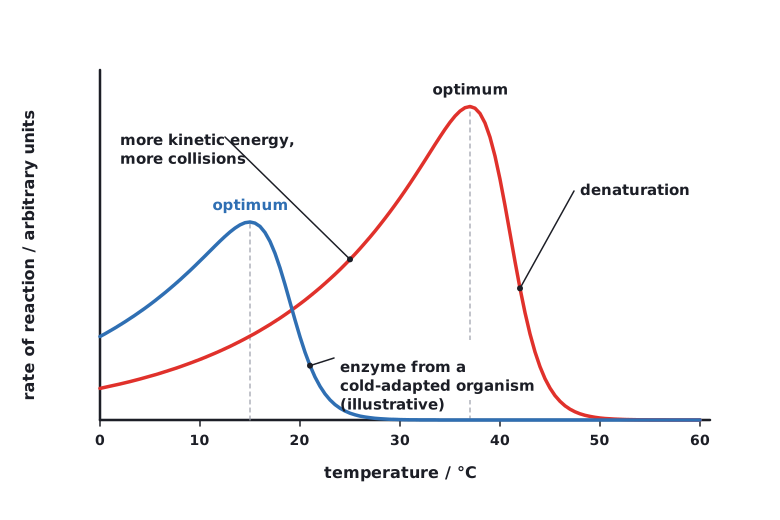
Temperature affects the rate of enzyme-controlled reactions: rate increases as kinetic energy rises, up to an optimum, and then falls as enzymes denature. The temperature coefficient Q₁₀ is the factor by which the rate increases for a 10 °C rise. Many organisms, especially ectotherms, are affected strongly by environmental temperature.
As temperature rises, enzyme and substrate molecules gain kinetic energy, so they collide more often and with more energy. More enzyme–substrate complexes form per second, and the rate of reaction increases. Above the optimum temperature, hydrogen and other bonds that hold the tertiary structure break, the active site changes shape and the enzyme denatures, so the rate falls rapidly.
 (opens full size in a new tab)
The temperature coefficient, Q₁₀
- Q₁₀
- The factor by which the rate of a reaction (or process) increases when the temperature is raised by 10 °C.
For many enzyme-controlled reactions Q₁₀ is about 2, meaning that the rate doubles for each 10 °C rise, below the optimum. A Q₁₀ of 1 means that temperature has no effect, which is typical of processes limited by something other than temperature. Physical processes such as diffusion have a Q₁₀ only a little above 1. A Q₁₀ below 1 occurs above the optimum, as enzymes denature.
Calculating Q₁₀
A seedling uses oxygen at a rate of 12 mm³ min⁻¹ at 15 °C and at 30 mm³ min⁻¹ at 25 °C. Calculate Q₁₀ for oxygen consumption.
- The two temperatures are 10 °C apart, so Q₁₀ = rate at 25 °C ÷ rate at 15 °C
- Q₁₀ = 30 ÷ 12
Answer: Q₁₀ = 2.5
Extension (beyond the specification): Q₁₀ for a temperature difference other than 10 °C
The rate of a reaction is 4.0 units at 10 °C and 9.0 units at 20 °C, then 11.0 units at 30 °C. Calculate Q₁₀ between 10 and 30 °C.
- Q₁₀ = (R₂ ÷ R₁)^(10 ÷ (T₂ − T₁))
- R₂ ÷ R₁ = 11.0 ÷ 4.0 = 2.75; exponent = 10 ÷ 20 = 0.5
- Q₁₀ = 2.75^0.5
Answer: Q₁₀ = 1.7 (to 2 significant figures). This is an average over 20 °C: the rise in rate is smaller between 20 and 30 °C (a ratio of 1.2) because the rate is levelling off as the optimum is approached.
Q₁₀ has no unit. Check that you divide the higher temperature’s rate by the lower temperature’s rate, and make sure the temperature interval is exactly 10 °C. If you are given a graph, read off the rates at two temperatures 10 °C apart.
Impact on plants, animals and microorganisms
- Most plants, microorganisms and many animals (ectotherms, such as insects and reptiles) have a body temperature that follows the environment. A rise in environmental temperature increases metabolic rate, growth and development. Photosynthesis and respiration enzymes have optima, so above this the rate falls.
- Endotherms (birds and mammals) maintain a constant body temperature, so enzymes work at the optimum, but at a cost of energy.
- Microorganisms grow and reproduce faster as temperature rises to their optimum. This affects decomposition rates, the spread of pathogens and food spoilage.
- Extreme temperatures above the optimum denature enzymes, which can kill the organism. Organisms are adapted to their usual temperature range, and so can be put at risk by climate change.
In a Q₁₀ question, check that the interval is 10 °C. Then link to the effect on the organism: higher rate of metabolic reactions, faster development, or denaturation above the optimum.
Written and checked against the Edexcel International A Level Biology (YBI11) specification · Updated October 2026