
Core practical 17: exercise and spirometer tracesSpec 7.15
In short
A spirometer records the volume of air breathed in and out as a trace. From it you can find tidal volume, breathing rate, respiratory minute ventilation (tidal volume multiplied by breathing rate) and oxygen consumption, and compare them at rest and during exercise. All four increase with exercise.
Core practical 17: investigate the effects of exercise on tidal volume, breathing rate, respiratory minute ventilation, and oxygen consumption using data from spirometer traces.
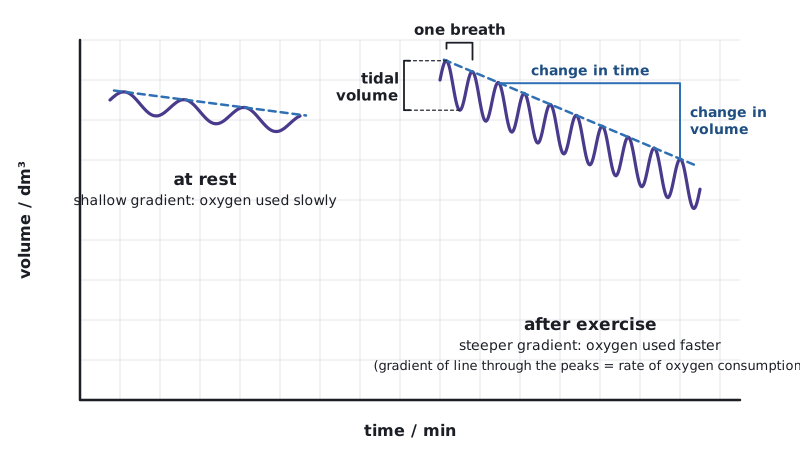
A spirometer is a chamber containing air or oxygen, with a lid that rises and falls as the person breathes in and out through a mouthpiece. The movements are recorded as a trace. Soda lime in the circuit absorbs the CO₂ breathed out, so the total volume of gas in the chamber falls as oxygen is consumed and the trace slopes downwards.
| Measurement | How to find it from the trace |
|---|---|
| Tidal volume | Volume of air breathed in or out in one breath (at rest or during exercise): the height from a trough to the next peak |
| Breathing rate | Number of peaks (breaths) per minute |
| Respiratory minute ventilation | Tidal volume × breathing rate (dm³ min⁻¹) |
| Oxygen consumption | The gradient (slope) of the trace over a set time, drawn through the peaks or troughs (dm³ min⁻¹) |
Spirometer trace
At rest, a spirometer trace shows a tidal volume of 0.5 dm³ and 14 breaths per minute. The trace falls from 3.0 dm³ to 2.4 dm³ in two minutes. Calculate the minute ventilation and the rate of oxygen consumption.
- Minute ventilation = 0.5 × 14 = 7.0 dm³ min⁻¹
- Fall in the trace = 3.0 − 2.4 = 0.6 dm³
- Rate = 0.6 ÷ 2 = 0.3 dm³ min⁻¹
Answer: Minute ventilation 7.0 dm³ min⁻¹; oxygen consumption 0.3 dm³ min⁻¹.
- Fill the spirometer chamber with medical-grade oxygen, check the soda lime is fresh and the mouthpiece is sterilised. The volunteer wears a nose clip.
- Record a trace at rest for a few minutes.
- The volunteer exercises for a set time (for example stepping or cycling), then breathes through the spirometer again and a trace is recorded at once. Repeat with different levels of exercise, with a rest period between.
- Process the traces for tidal volume, breathing rate, minute ventilation and oxygen consumption. Both ventilation and oxygen consumption increase with exercise.
- Safety and ethics: the volunteer gives informed consent and can stop at any time; check for asthma, heart conditions or other health problems before exercise; use a clean mouthpiece to avoid cross-infection; the soda lime is corrosive and oxygen is a fire risk, so keep flames away.
- Control variables: the same person, the same type and duration of exercise, the same starting volume in the chamber, the same time of day, and the same amount of rest.
 (opens full size in a new tab)
Quick check
What does myogenic mean?
Show answer
The heart muscle can contract and relax on its own, without nerve impulses.
Where is the sinoatrial node?
Show answer
In the wall of the right atrium.
What does the QRS complex on an ECG show?
Show answer
Depolarisation of the ventricles.
How do you calculate cardiac output?
Show answer
Stroke volume × heart rate.
Which part of the brain contains the ventilation centre?
Show answer
The medulla oblongata.
Written and checked against the Edexcel International A Level Biology (YBI11) specification · Updated October 2026