
Core practical 16: respirometer and RQSpec 7.8
In short
A simple respirometer measures the rate of respiration of germinating seeds or small invertebrates from the movement of fluid along a capillary tube. With carbon dioxide absorbed by potassium hydroxide, the movement shows oxygen consumed. Without the absorber, the net change allows carbon dioxide produced to be found, and so the RQ.
Core practical 16: use a simple respirometer to determine the rate of respiration and RQ of a suitable material (such as germinating seeds or small invertebrates).
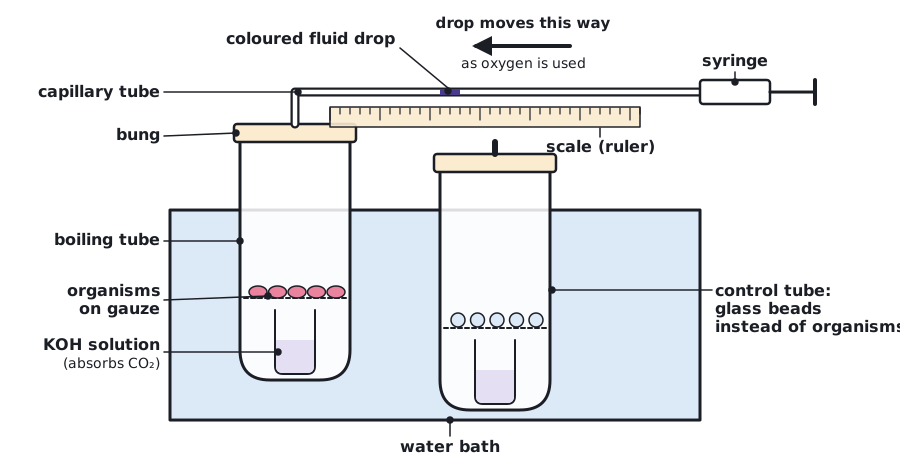
A simple respirometer is a sealed tube containing the organisms and connected to a capillary tube containing a drop of coloured fluid. As the organisms respire, the gas volume in the tube changes and the fluid moves.
- Place the organisms (for example germinating seeds or woodlice) in the tube on a gauze or platform, above a small tube of potassium hydroxide solution (or soda lime) that absorbs the CO₂ they produce. Keep the organisms from touching the potassium hydroxide.
- Set up a control tube, with an equal volume of glass beads or dead / boiled seeds in place of the organisms, to correct for changes in air temperature and pressure.
- Place the apparatus in a water bath at constant temperature and wait about 10 minutes for the temperature to equalise.
- Close the tap or bung, introduce a drop of coloured fluid and mark its position. Measure the distance it moves in a set time.
- Repeat without the potassium hydroxide to find the net change in gas volume.
With KOH present, CO₂ is absorbed, so the fluid moves towards the organisms by a distance that shows the oxygen consumed. Without KOH, O₂ is still used up but CO₂ is released, so the movement is smaller (zero if RQ = 1, or away from the organisms if RQ is above 1) and shows the oxygen consumed minus the carbon dioxide produced. The volume of gas is calculated from the capillary's radius: volume = πr² × distance moved.
Rate of respiration and RQ
In a respirometer, the fluid in a capillary tube of radius 0.5 mm moved 24 mm in 5 minutes with potassium hydroxide present. Without potassium hydroxide it moved 6 mm in 5 minutes. Calculate the rate of oxygen uptake and the RQ.
- Volume of O₂ consumed = πr² × distance = π × 0.5² × 24 = 18.85 mm³
- Rate of O₂ uptake = 18.85 ÷ 5 = 3.77 mm³ min⁻¹
- Without KOH, net volume decrease = π × 0.5² × 6 = 4.71 mm³, which is O₂ consumed − CO₂ produced
- CO₂ produced = 18.85 − 4.71 = 14.14 mm³
- RQ = CO₂ produced ÷ O₂ consumed = 14.14 ÷ 18.85
Answer: Rate of oxygen uptake = 3.77 mm³ min⁻¹ (accept 3.8). RQ = 0.75, so the organism is probably respiring mostly lipid or a mixture of substrates.
- Variables: independent variable e.g. temperature or type of organism; dependent variable distance moved by the fluid in a set time. Control the mass of organisms, temperature, time and the volume of apparatus.
- Divide by the mass of the organisms to compare rates, e.g. mm³ O₂ g⁻¹ min⁻¹.
- Risks: potassium hydroxide is corrosive, so wear eye protection and gloves and prevent contact with the organisms. Handle animals gently and return them to their habitat, and wash hands after handling germinating seeds.
The respirometer works because CO₂ is absorbed. Be clear which gas each reading refers to: with KOH the movement is due to O₂ used; without KOH the movement is O₂ used minus CO₂ produced.
 (opens full size in a new tab)
Quick check
What is the formula for the respiratory quotient?
Show answer
RQ = volume of CO₂ produced ÷ volume of O₂ consumed.
What is the typical RQ when carbohydrate is respired?
Show answer
About 1.0.
In Core practical 15, why does the redox indicator change colour?
Show answer
It accepts hydrogen from dehydrogenase enzymes, so it is reduced and loses its blue colour.
In a respirometer, what is the purpose of potassium hydroxide?
Show answer
It absorbs carbon dioxide, so that the movement of fluid shows the volume of oxygen consumed.
Written and checked against the Edexcel International A Level Biology (YBI11) specification · Updated October 2026