
Core practical 2: vitamin C content of food and drinkSpec 1.14
In short
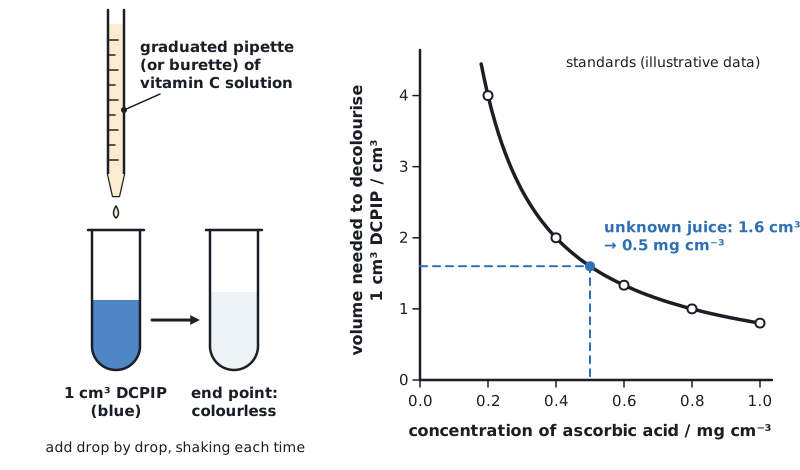
Vitamin C (ascorbic acid) reduces the blue dye DCPIP to a colourless form. Adding a food or drink extract to a fixed volume of DCPIP until it just turns colourless shows how much vitamin C it contains: a smaller volume needed means a higher concentration. Standards of known concentration give a calibration to calculate the unknown.
Core practical 2: investigate the vitamin C content of food and drink.
DCPIP (dichlorophenolindophenol) is a blue dye. Vitamin C (ascorbic acid) is a reducing agent: it reduces DCPIP to a colourless compound. The more vitamin C a solution contains, the less of it is needed to decolourise the same volume of DCPIP.
- Make standard solutions of ascorbic acid of known concentration (for example 1.0 mg cm⁻³ and dilutions of it).
- Place a fixed volume of DCPIP solution (for example 1 cm³) in a test tube or small beaker.
- Add the first standard drop by drop from a graduated pipette or burette, shaking the tube after each drop, until the blue colour just disappears. Record the volume added.
- Repeat with each standard and plot a calibration curve of volume needed against concentration (or use the standard which decolourises 1 cm³ DCPIP to find its equivalent).
- Extract juice from a solid food by crushing it in water and filtering, then treat the unknown in exactly the same way. Repeat each measurement at least three times and calculate a mean.
- Use the volume needed and the calibration to find the vitamin C concentration of the unknown.
| Type | Variable |
|---|---|
| Independent | Type of food or drink, or its treatment (for example fresh or boiled) |
| Dependent | Volume of sample needed to decolourise DCPIP, which gives the vitamin C concentration |
| Controlled | Volume and concentration of DCPIP, temperature, rate of adding drops, same measuring equipment, fresh solutions each time, time between preparing and testing |
Risks: DCPIP can stain and irritate skin and eyes, so wear eye protection and gloves and wipe spillages. Do not eat or drink any food used in the laboratory.
Limitations: vitamin C is destroyed by heat, light and air (oxidation), so keep solutions cool and fresh and test promptly. Other reducing substances in a food may also decolourise DCPIP. The end point is judged by eye, which is more difficult in coloured juices, so dilute the juice or use a paler food, and use the same observer.
Calculating vitamin C concentration
It takes 0.8 cm³ of a 1.0 mg cm⁻³ ascorbic acid standard to decolourise 1 cm³ of DCPIP. It takes 1.6 cm³ of fruit juice to decolourise 1 cm³ of the same DCPIP. Calculate the vitamin C concentration of the juice, and the percentage change if boiling the juice raises the volume needed to 2.0 cm³.
- Mass of vitamin C that decolourises 1 cm³ DCPIP = 0.8 cm³ × 1.0 mg cm⁻³ = 0.8 mg
- Concentration of juice = 0.8 mg ÷ 1.6 cm³ = 0.5 mg cm⁻³
- Boiled juice = 0.8 mg ÷ 2.0 cm³ = 0.4 mg cm⁻³
- Percentage change = (0.4 − 0.5) ÷ 0.5 × 100 = −20 %
Answer: 0.5 mg cm⁻³; boiling reduced the concentration by 20 %.
Percentage change = (new value − original value) ÷ original value × 100. A negative answer is a decrease. Show the working and include units for concentrations.
 (opens full size in a new tab)
Quick check
Name the four stages in the course of events leading to atherosclerosis.
Show answer
Endothelial dysfunction, inflammatory response, plaque formation and raised blood pressure.
What does thrombin do?
Show answer
It is an enzyme that catalyses the conversion of soluble fibrinogen to insoluble fibrin.
Give two ways smoking raises the risk of CVD.
Show answer
Any two of: carbon monoxide reduces oxygen carried by haemoglobin; nicotine raises heart rate and blood pressure; chemicals damage the endothelium; platelets are stickier.
How do antioxidants reduce the risk of CVD?
Show answer
They neutralise free radicals, so less LDL is oxidised and there is less endothelial damage and foam cell formation.
In Core practical 2, what colour change shows vitamin C?
Show answer
Blue DCPIP turns colourless.
Written and checked against the Edexcel International A Level Biology (YBI11) specification · Updated October 2026