
Making recombinant DNASpec 8.18
In short
Recombinant DNA is DNA made by joining DNA from different sources. A restriction endonuclease cuts a gene and a plasmid vector at the same recognition sequence, leaving complementary sticky ends. These base-pair together and DNA ligase joins the sugar–phosphate backbones, forming a recombinant plasmid.
Recombinant DNA is DNA made by joining DNA from two different sources, usually from different organisms. A gene from one organism is combined with a vector, usually a plasmid (a small circular DNA molecule from bacteria), which carries the gene into a host cell.
Getting the gene
- Using reverse transcriptase: mRNA for the gene is extracted from cells that make a lot of it (for example, insulin mRNA from pancreatic beta cells). Reverse transcriptase makes a complementary DNA (cDNA) copy, and DNA polymerase makes it double-stranded. cDNA has no introns, so a bacterium can express it.
- Using restriction endonucleases to cut the gene out of the genome.
- Synthesising the gene from its known base sequence in a gene machine.
Joining the gene to the plasmid
- A restriction endonuclease (restriction enzyme) cuts DNA at a specific base sequence called its recognition site (often a palindromic sequence). It hydrolyses the phosphodiester bonds in each strand.
- Many restriction enzymes make staggered cuts, leaving short single-stranded ends called sticky ends.
- The plasmid is cut with the same restriction enzyme, so its sticky ends are complementary to those on the gene.
- The gene and plasmid are mixed. The sticky ends join by hydrogen bonds between complementary bases (annealing).
- DNA ligase forms phosphodiester bonds between the sugar and phosphate groups of adjacent nucleotides (a condensation reaction), sealing the gaps in the backbone to make a recombinant plasmid.
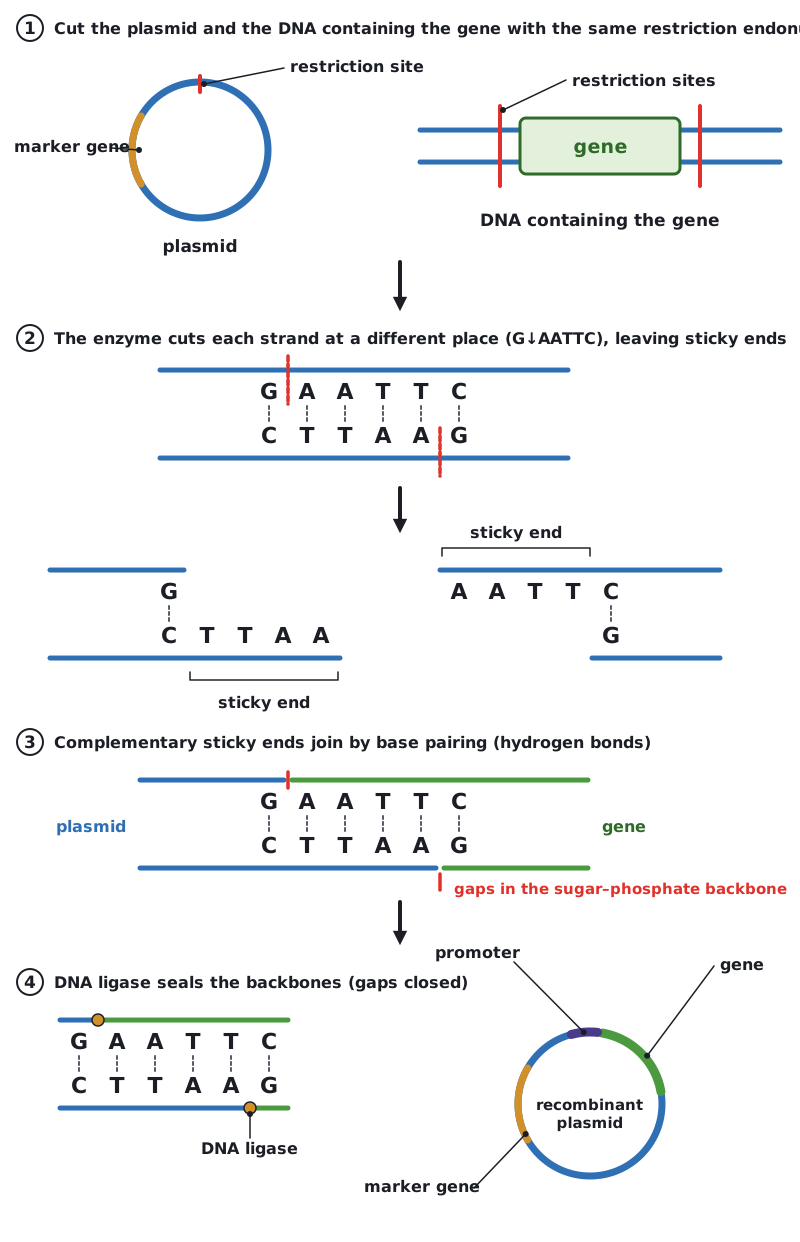 (opens full size in a new tab)
Restriction enzymes and ligase have opposite roles: restriction enzymes cut (hydrolysis) and ligase joins (condensation). The sticky ends are held by hydrogen bonds between bases; ligase makes the covalent bonds.
Written and checked against the Edexcel International A Level Biology (YBI11) specification · Updated October 2026