
TranscriptionSpec 2.13
In short
Transcription is the first stage of protein synthesis. In the nucleus, RNA polymerase attaches to a gene, breaks hydrogen bonds between the two DNA strands and builds a single strand of messenger RNA. Free RNA nucleotides pair with the bases of the template (antisense) strand and are joined by phosphodiester bonds.
Protein synthesis has two stages: transcription (making mRNA from DNA in the nucleus) and translation (making a polypeptide from mRNA at a ribosome). DNA stays in the nucleus, so a copy of the gene, messenger RNA (mRNA), carries the instructions to the cytoplasm.
- RNA polymerase attaches to the DNA at the start of the gene. The two strands separate as the enzyme breaks the hydrogen bonds between bases.
- One strand, the template (antisense) strand, is used to make the mRNA. The other strand, the sense (coding) strand, has the same base sequence as the mRNA (but with T instead of U).
- Free RNA nucleotides pair with the complementary bases on the template strand: A–U, T–A, C–G, G–C.
- RNA polymerase joins the RNA nucleotides together by phosphodiester bonds, to make a strand of mRNA.
- The DNA strands re-join behind the enzyme. When RNA polymerase reaches a stop signal at the end of the gene, mRNA is released and leaves the nucleus through a nuclear pore.
| Strand | Base sequence |
|---|---|
| Template (antisense) strand of DNA | T A C G C A T T T |
| mRNA transcribed | A U G C G U A A A |
| Sense (coding) strand of DNA | A T G C G T A A A |
Questions on the 'role of the template strand' want: it is the strand copied by RNA polymerase, and the mRNA base sequence is complementary to it. A common error is to transcribe the sense strand.
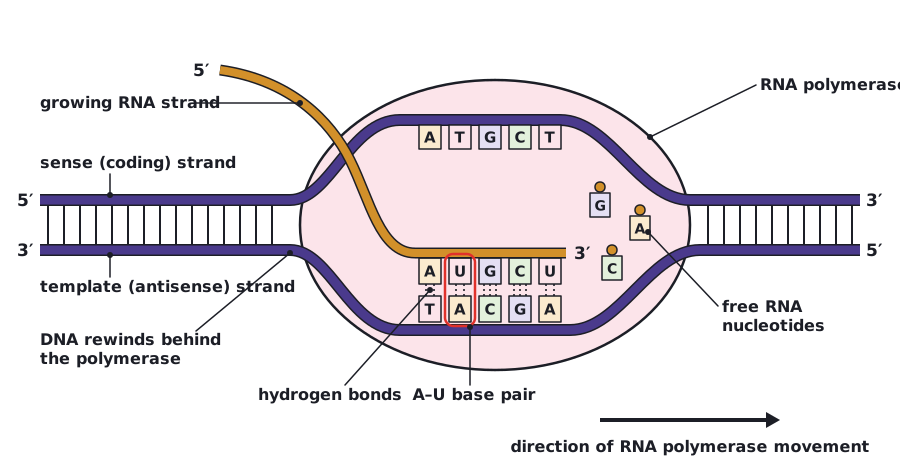 (opens full size in a new tab)
Written and checked against the Edexcel International A Level Biology (YBI11) specification · Updated October 2026