
Efficiency of biomass and energy transfersSpec 5.10
In short
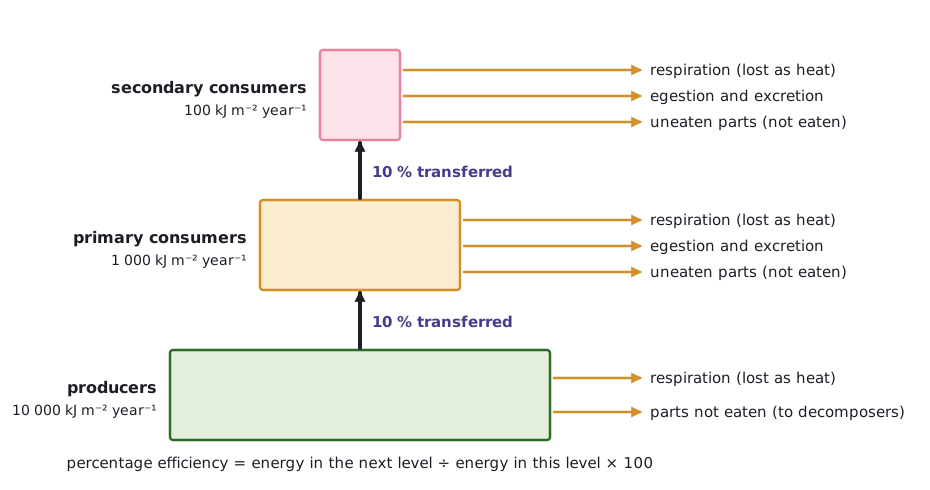
The efficiency of a transfer between trophic levels is the energy (or biomass) passed to the next level, divided by the energy (or biomass) available from the previous level, multiplied by 100. Efficiency is low because energy is lost in respiration, as heat, and in uneaten, egested and excreted material.
Use the same units for both trophic levels. Energy transfer is usually measured in kJ m⁻² year⁻¹, and biomass transfer as dry mass in g m⁻² year⁻¹. Dry mass is used because water content varies and water holds no chemical energy.
Calculating efficiency of energy transfer
Grass in a meadow has an NPP of 8 400 kJ m⁻² year⁻¹. Rabbits feeding on the grass gain 840 kJ m⁻² year⁻¹ of energy in their biomass. Calculate the efficiency of transfer from grass to rabbits.
- efficiency = energy in rabbits ÷ energy in grass × 100
- = 840 ÷ 8 400 × 100
Answer: 10 %
Why transfers are inefficient
- Not all of the organism is eaten: bones, roots, shells, hair and other parts are left uneaten.
- Some of what is eaten is not digested and is lost in faeces (egestion).
- Some absorbed material is lost as excretory products such as urea (excretion), which contains energy.
- Energy is lost as heat from respiration in the consumer, to power movement, active transport and other processes (and, in birds and mammals, to maintain body temperature). This energy is not available to the next trophic level.
- Not all individuals are eaten: some die of disease or old age and pass to decomposers.
Because of these losses, the biomass and energy at each trophic level are lower than in the level before it. This is why food chains rarely have more than four or five trophic levels, and why pyramids of energy are always pyramid-shaped. Transfers are often less efficient from producer to primary consumer (plants contain indigestible cellulose and lignin) and are higher for carnivores (whose food is easier to digest).
 (opens full size in a new tab)
When explaining energy loss, name the process (respiration, egestion, excretion) and say what happens to the energy (lost as heat; held in material that passes to decomposers). Marks are rarely given for 'energy is lost' on its own.
Written and checked against the Edexcel International A Level Biology (YBI11) specification · Updated October 2026