
Ultrastructure of prokaryotic cellsSpec 3.5
In short
A prokaryotic cell such as a bacterium has no nucleus or membrane-bound organelles. It has a cell wall, sometimes a protective capsule, circular DNA, small plasmids, smaller 70S ribosomes, and may have a flagellum for movement and pili for attachment. Each structure has a specific function.
Prokaryotic cells (bacteria) are much smaller than eukaryotic cells and are structurally simpler. As well as a cell surface membrane and cytoplasm, you need to know these structures.
| Structure | Description | Function |
|---|---|---|
| Cell wall | Made of peptidoglycan (a polymer of sugars and amino acids) | Maintains the shape of the cell and prevents it bursting by osmosis |
| Capsule | Slimy layer of polysaccharide outside the cell wall (not all bacteria have one) | Protects the cell from drying out and from attack by the immune system, and helps cells stick to surfaces |
| Plasmid | Small loop of circular DNA, separate from the main DNA; may be many copies | Carries extra genes, for example for antibiotic resistance; can be passed to other bacteria |
| Flagellum | Long, thin, whip-like protein filament, rotated by a motor in the cell wall and membrane | Propels the cell (movement) |
| Pili | Short, thin protein hairs on the surface | Attach the cell to surfaces and to other cells; a special pilus allows DNA transfer between bacteria |
| Ribosomes | 70S: smaller than eukaryotic 80S ribosomes | Protein synthesis |
| Circular DNA | A single, closed loop, not wound around histones, lying free in the cytoplasm in a region called the nucleoid | Carries the genes the cell needs |
Common mistake:
Prokaryotic DNA is not 'in a nucleus'. Say it is circular and lies free in the cytoplasm, with no nuclear envelope.
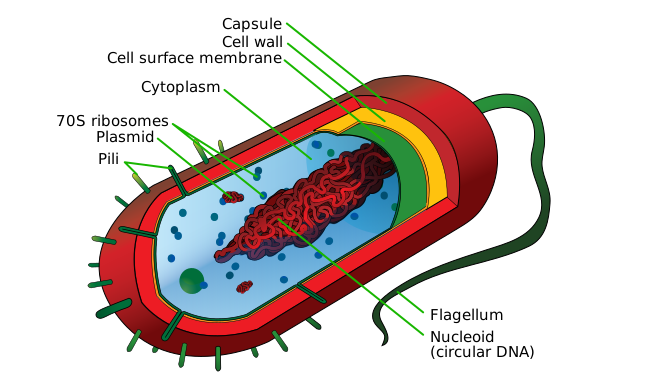 (opens full size in a new tab)
Written and checked against the Edexcel International A Level Biology (YBI11) specification · Updated October 2026