
Core practical 8: tensile strength of plant fibresSpec 4.9
In short
Tensile strength is the maximum force per unit cross-sectional area a fibre can withstand before it breaks. It is measured by hanging increasing masses from a fibre of known length and diameter until it snaps, then dividing the breaking force by the cross-sectional area. Fibre length, diameter and moisture must be controlled.
Core practical 8: determine the tensile strength of plant fibres.
- Tensile strength
- The maximum force per unit cross-sectional area that a material can withstand when it is pulled before it breaks. Units: N mm⁻² or Pa (1 N mm⁻² = 1 MPa).
Method
- Cut fibres of the same length from each plant being compared (for example 20 cm). Measure the diameter at several points with a micrometer or under a microscope with a graticule, and calculate the mean radius.
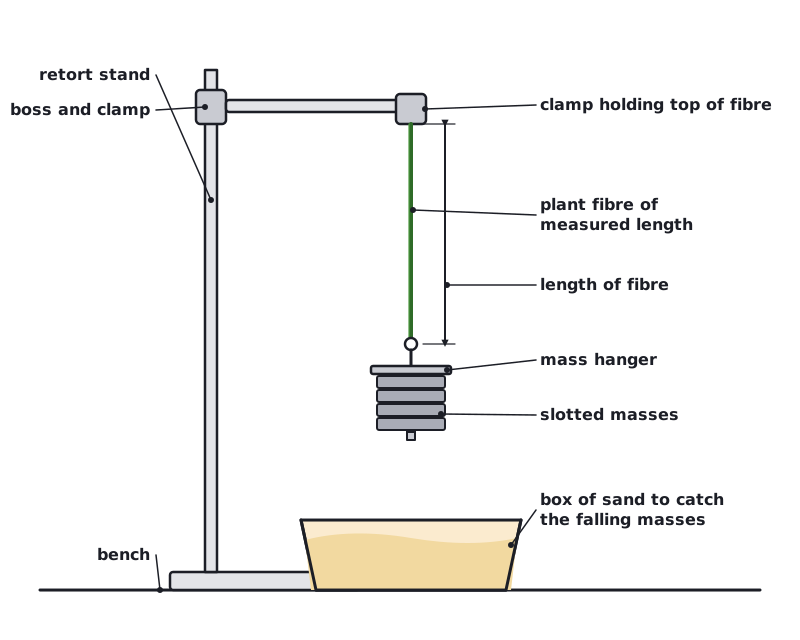
- Clamp one end of the fibre firmly to a retort stand at the top. Tie a mass hanger securely to the other end.
- Place a box of soft material, such as sand or cushioning, below the hanger, and wear eye protection and closed shoes.
- Add masses one at a time (for example 100 g), waiting a few seconds each time, until the fibre breaks.
- Record the total mass, including the hanger, at which the fibre broke. Repeat with at least five fibres of each type and calculate a mean.
- Calculate the breaking force, the cross-sectional area from the radius, and then the tensile strength.
| Type | Variable | How |
|---|---|---|
| Independent | Type of plant fibre (or treatment) | Choose fibres from different plants |
| Dependent | Mass or force at which the fibre breaks | Add masses until the fibre snaps |
| Control | Length of fibre; diameter (or calculate per unit area); moisture content; temperature; how the fibre is attached; size of mass increments | Same length, same age and storage, same increments and time between additions |
 (opens full size in a new tab)
Risks and reliability
- Falling masses can injure feet: use a box of soft material and closed shoes.
- Fibres may snap near the knot or clamp. Discard these as anomalies and repeat.
- Fibres vary in thickness along their length, so measure the diameter in several places and calculate area per fibre.
- Repeating with many fibres and calculating a mean improves reliability. Use the same increments of mass for all fibres.
Calculating tensile strength
A plant fibre of diameter 0.40 mm breaks when the total mass hanging from it is 4.5 kg. Calculate the tensile strength in N mm⁻². Use g = 9.81 N kg⁻¹.
- force = 4.5 × 9.81 = 44.1 N
- radius = 0.40 ÷ 2 = 0.20 mm, so area = π × 0.20² = 0.126 mm²
- tensile strength = 44.1 ÷ 0.126
Answer: 350 N mm⁻² (to 2 significant figures)
Show every step: convert mass to force, convert diameter to radius, then area, then divide. Check that the units match (N and mm²).
Quick check
Name the tissue that carries sucrose around the plant.
Show answer
Phloem (sieve tubes).
Why can xylem vessels carry water in one continuous column?
Show answer
They are dead, have no cell contents and no end walls, so form a hollow tube.
State the formula for magnification.
Show answer
Magnification = size of image ÷ size of real object.
Why do plants need magnesium ions?
Show answer
Magnesium is the central atom in chlorophyll, so it is needed to make chlorophyll for photosynthesis.
Give the unit of tensile strength.
Show answer
N mm⁻² (equivalent to MPa) or Pa.
Written and checked against the Edexcel International A Level Biology (YBI11) specification · Updated October 2026