
Core practical 12: temperature and the development of organismsSpec 5.22
In short
Core practical 12 investigates the effect of temperature on the development of organisms, for example the growth rate of seedlings or the hatching of brine shrimp eggs. Temperature is the independent variable, set with water baths or incubators, while all other variables are controlled. The investigation must take account of the ethical use of living organisms.
Core practical 12: investigate the effects of temperature on the development of organisms (such as seedling growth rate or brine shrimp hatch rates), taking into account the ethical use of organisms.
Brine shrimp hatching
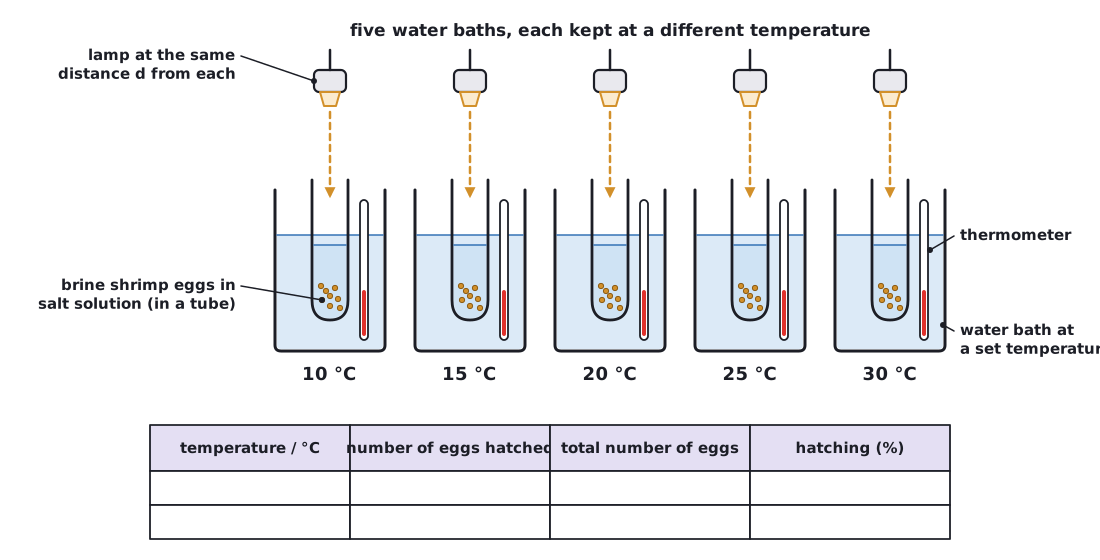
- Set up several water baths or incubators at different temperatures (for example 15, 20, 25, 30 and 35 °C), and check each with a thermometer.
- Prepare salt solution of the same concentration for each (brine shrimp eggs need salt water). Add the same volume to each container, and equilibrate to the required temperature.
- Add the same number (or mass) of brine shrimp eggs to each container.
- Keep all other conditions the same (light, salinity, volume, aeration).
- After a set time (for example 24 or 48 hours), count the number of hatched shrimp (nauplii) in a sample or the whole container, and calculate the percentage hatching. Repeat several times at each temperature.
Seedling growth
Germinate the same number of seeds (for example cress or mustard) of one variety on damp filter paper at each temperature. Measure the length of the shoots (or their mass) at regular intervals, over several days. Calculate the rate of growth as change in length ÷ time. Keep light, water and seed mass the same.
 (opens full size in a new tab)
Variables and processing
| Variable | Detail |
|---|---|
| Independent | Temperature (°C) |
| Dependent | Number or percentage of eggs hatched in a set time, or rate of seedling growth (mm day⁻¹) |
| Controlled | Number and age of eggs/seeds, same batch of organisms, salinity or water volume, light, time, aeration, container type |
Calculate a mean from at least three replicates at each temperature. Plot hatching or growth rate against temperature. Calculate Q₁₀ from values 10 °C apart on the rising part of the curve. Beyond the optimum the rate falls because enzymes denature, or the organisms die.
Ethical use of organisms
- Use the minimum number of organisms needed to get valid results, and treat them humanely.
- Avoid temperatures that would cause unnecessary suffering or death: for animals, keep within a range they would naturally experience, and do not leave them at extreme temperatures for longer than necessary.
- Keep them in suitable conditions (salinity, oxygen, food). At the end, do not release brine shrimp into local waters (they may not be native); keep them or dispose of them humanely. Seedlings can be disposed of in normal waste.
- Consider whether the use of living animals is justified, and whether seedlings (plants) could be used instead.
If asked to justify the ethical approach, name the organism and the specific action, such as 'use the smallest number of shrimp and avoid temperatures above their tolerance'.
Written and checked against the Edexcel International A Level Biology (YBI11) specification · Updated October 2026