
Urea production and ultrafiltrationSpec 7.19
In short
Excess amino acids cannot be stored, so in the liver the amino group is removed by deamination and converted to urea, which is less toxic. Urea is carried in the blood to the kidneys, where ultrafiltration at the glomerulus forces small molecules, including urea, through the capillary wall, basement membrane and podocytes into Bowman's capsule.
Making urea in the liver
- Amino acids not needed for protein synthesis cannot be stored. In the liver, the amino group is removed from each excess amino acid (deamination), forming ammonia and a keto acid.
- The keto acid can be respired or converted to carbohydrate or fat.
- Ammonia is toxic and very soluble, so it is combined with carbon dioxide in the ornithine cycle (details are not required) to make urea, using ATP.
- Urea is soluble and much less toxic. It is carried in the blood plasma to the kidneys.
Ultrafiltration
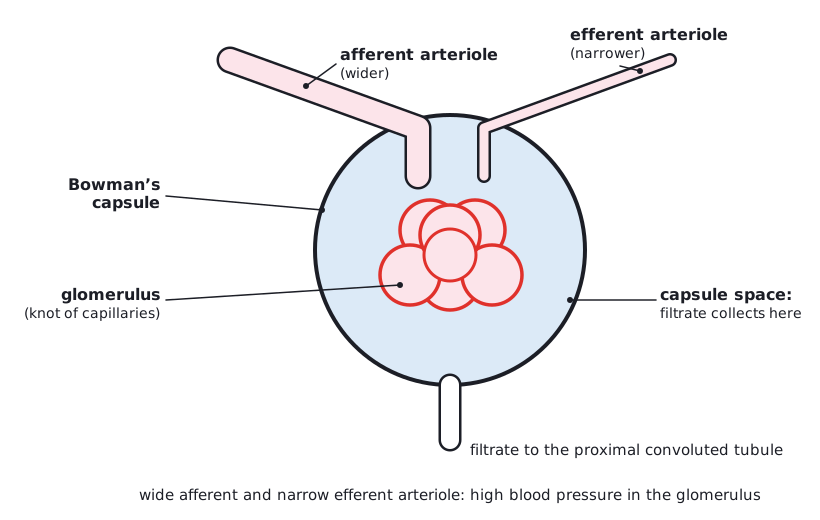
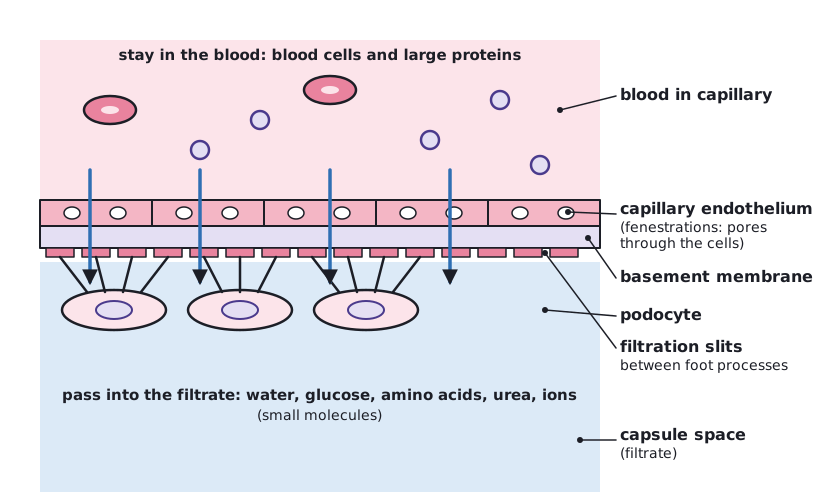
Ultrafiltration is filtration at the molecular level. Blood in the glomerulus is at high hydrostatic pressure, because the afferent arteriole is wider than the efferent arteriole. This forces water and small solutes out of the capillaries into the Bowman's capsule, through three layers:
- the fenestrated capillary endothelium, whose cells have many small pores (fenestrations) through them;
- the basement membrane, a mesh of collagen and glycoproteins that acts as the filter and stops large proteins;
- the podocytes of the Bowman's capsule, which have filtration slits between their feet-like extensions.
The glomerular filtrate contains water, glucose, amino acids, urea and inorganic ions. It does not contain blood cells or large plasma proteins, which are too large to pass through. The pressure is opposed by the water potential of the blood (which is lowered by the plasma proteins) and the pressure of fluid in the capsule. The volume filtered is about 125 cm³ per minute in humans.
State all three layers and the reason for the high pressure (wide afferent, narrow efferent arteriole). 'Ultrafiltration' needs a high pressure, not just a membrane.
 (opens full size in a new tab)
 (opens full size in a new tab)
Written and checked against the Edexcel International A Level Biology (YBI11) specification · Updated October 2026