
Evaluating zoos and seed banks in conservationSpec 4.21
In short
Zoos conserve endangered animals through captive breeding programmes, reintroduction programmes, scientific research and education. Seed banks store seeds as a low-cost way of conserving plant species and their genetic diversity. Each approach has strengths and limitations, which must be weighed up to evaluate how effective it is.
Zoos
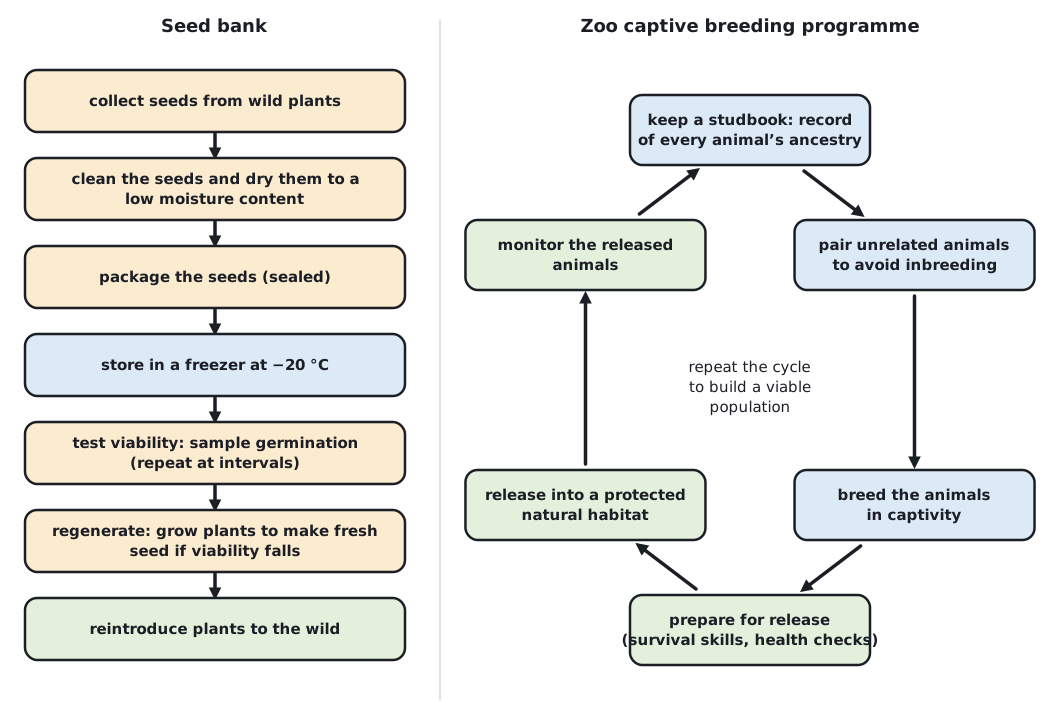
- Captive breeding programmes: animals are bred under controlled conditions. Studbooks record pedigrees and animals are exchanged between zoos so mating partners are unrelated, to maintain genetic diversity and avoid inbreeding.
- Reintroduction programmes: animals bred in captivity are released into protected habitat, increasing wild populations.
- Scientific research: study of the biology, behaviour and breeding of species, and techniques such as artificial insemination and embryo storage, help conservation in the wild.
- Education: visitors learn about threatened species, which increases support and funding.
Seed banks
Seed banks store seeds from many species, dried to a low water content and kept at low temperature (for example −20 °C), which slows metabolism and keeps seeds viable for many years. Seeds can later be germinated to grow new plants or to reintroduce a species.
- Seeds are collected from many plants across a species' range, to capture as much of its genetic diversity as possible.
- Scientific research: seed banks study the best conditions for drying, storing and germinating each species, and regularly test samples for viability by germinating them.
- Reintroduction: plants grown from stored seeds can be used to restore populations in protected or restored habitats.
- Education: seed banks and botanic gardens explain the value of plant diversity, for example as a source of food crops and medicines.
| Strengths | Limitations | |
|---|---|---|
| Zoos | Protect animals from threats such as hunting and habitat loss; managed breeding maintains genetic diversity; research and education; reintroduction can restore wild populations | Expensive and space-limited, so only a few individuals of a few species; small populations may lose genetic diversity; animals may lose natural behaviours and not survive reintroduction; habitat must still be protected for release; risk of disease |
| Seed banks | Cheap, take little space and store many individuals of many species; protect against loss in the wild; store a wide range of alleles for future use; seeds can be tested for viability and regrown | Some seeds cannot be dried or frozen; seeds may lose viability, so need testing and regrowing; plants in storage do not adapt to changing conditions; seeds from small samples may carry limited genetic diversity; a reintroduction needs suitable habitat |
In evaluate questions give a balanced judgement: weigh strengths against limitations and end with a reasoned conclusion, for example that both are useful but only if natural habitats are also protected.
 (opens full size in a new tab)
Quick check
Define niche.
Show answer
The role of a species within its habitat, including how it obtains resources and its interactions with other species.
Name the three types of adaptation.
Show answer
Behavioural, anatomical and physiological.
In the Hardy-Weinberg equation, what does 2pq represent?
Show answer
The frequency of the heterozygous genotype.
Name two causes of changes in allele frequency.
Show answer
Mutation and natural selection.
Why are seeds dried before storage in a seed bank?
Show answer
To reduce water content, which slows metabolism and prevents germination and damage from ice crystals.
Written and checked against the Edexcel International A Level Biology (YBI11) specification · Updated October 2026