
Core practical 14: effect of antibiotics on bacteriaSpec 6.14
In short
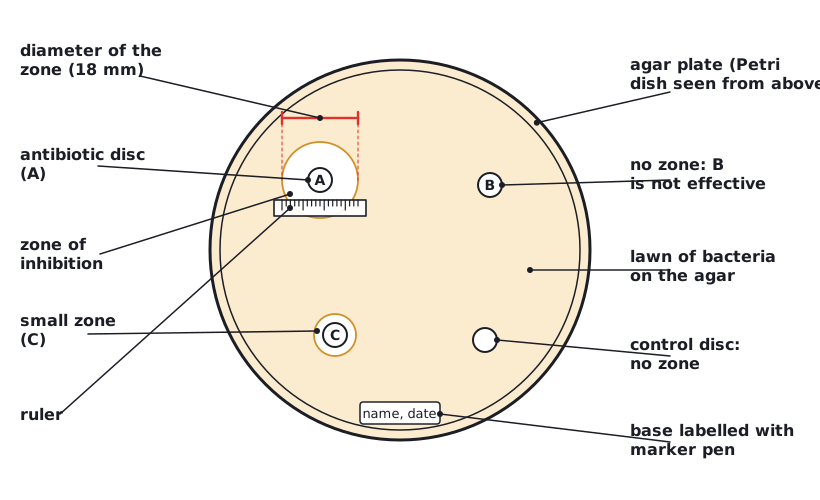
In core practical 14 a lawn of non-pathogenic bacteria is spread on agar and discs soaked in different antibiotics, with a control disc, are placed on it. After incubation the clear zones of inhibition are measured; larger zones mean the antibiotic is more effective.
Core practical 14: Investigate the effect of different antibiotics on bacteria.
Method
- Use aseptic technique. Sterilise Petri dishes of nutrient agar; label the base with names of antibiotics, date and your initials.
- Use a sterile pipette to put a measured volume (for example 0.1 cm³) of a broth culture of a non-pathogenic bacterium, such as Escherichia coli K12, on to the agar and spread it evenly over the surface with a sterile spreader to give a lawn.
- Using sterile forceps (flamed and cooled), place sterile paper discs soaked in different antibiotics at equal spacing on the lawn, and press gently. Include a control disc soaked in sterile water (or no antibiotic).
- Replace the lid, tape it with two or four short pieces of tape, invert the plate and incubate at 25 °C for 24 to 48 hours (not above 30 °C).
- Measure the diameter of each clear zone (zone of inhibition) with a ruler, across the centre of the disc, in two directions at right angles, and take the mean. Calculate the area of the zone using πr² if needed.
- Disinfect or autoclave the plates before disposal. Do not open the plates after incubation.
| Type | Examples |
|---|---|
| Independent variable | Type of antibiotic (or concentration of one antibiotic) |
| Dependent variable | Diameter or area of the zone of inhibition |
| Controlled variables | Volume and type of bacterial culture; agar type and depth; disc size and volume of antibiotic; incubation time and temperature; spacing of discs |
| Control | A disc without antibiotic (sterile water) shows that the disc and the water do not themselves stop growth |
Interpreting results
Around an effective antibiotic the bacteria cannot grow, leaving a clear zone of inhibition. A bigger zone means the bacteria are more susceptible to that antibiotic (or the antibiotic diffuses well), so the bigger the zone, the more effective the antibiotic. No zone means the bacteria are resistant. Colonies growing within the zone suggest resistant mutants.
Area of a zone of inhibition
The diameter of a zone of inhibition around a disc was 22 mm. Calculate the area of the zone.
- Radius = 22 ÷ 2 = 11 mm.
- Area = πr² = π × 11² = π × 121.
- Area = 380 mm² (to 3 significant figures).
Answer: 380 mm²
Compare areas, not diameters, if the question asks 'how many times larger'. Remember to halve the diameter before squaring.
Safety and limitations
- Use only non-pathogenic bacteria; do not incubate at 37 °C; keep plates taped and closed after incubation; wash hands; disinfect bench; autoclave plates.
- The zone depends on how fast each antibiotic diffuses through agar, not only on how effective it is, which limits the comparison. Zones may overlap if discs are too close.
- Results can be improved with repeats (several plates per antibiotic), a standard concentration, and standard disc size.
 (opens full size in a new tab)
Written and checked against the Edexcel International A Level Biology (YBI11) specification · Updated October 2026