
Core practical 1: Benedict’s reagent and iodine solutionSpec 1.3
In short
A semi-quantitative method estimates concentration by matching a colour to standards of known concentration. Benedict’s reagent, heated with a reducing sugar, changes from blue through green, yellow and orange to brick-red as concentration rises. Iodine solution changes from yellow-brown to blue-black as starch concentration rises. Volumes, temperature and timing must be kept the same.
Core practical 1: use a semi-quantitative method with Benedict’s reagent to estimate the concentration of reducing sugars, and with iodine solution to estimate the concentration of starch, using colour standards.
Semi-quantitative means the answer is an estimate from comparing colours, not an exact measurement. You make a set of colour standards (solutions of known concentration), treat them in exactly the same way as the unknown, and match the unknown to the closest standard. The reducing sugars you meet are glucose, fructose, galactose, maltose and lactose. Sucrose and starch are not reducing sugars.
Method: reducing sugar with Benedict’s reagent
- Make colour standards from a stock solution of glucose (for example 2.0 % glucose) by dilution with distilled water, to give about five known concentrations plus a water-only blank.
- Put the same volume of each standard (for example 2 cm³) into a labelled boiling tube. Do the same with the unknown solution.
- Add the same volume of Benedict’s reagent (for example 2 cm³) to every tube.
- Heat all the tubes together in a water bath at the same temperature (a hot water bath, about 90 °C or above) for the same length of time (for example 3 minutes).
- Remove the tubes, let any precipitate settle and compare the colours against a white background. Record colours: blue (none), green, yellow, orange, brick-red (highest concentration).
- Match the unknown to the closest colour standard and state the estimated concentration. Repeat the unknown at least three times.
Method: starch with iodine solution
Prepare standards of starch (for example 0.0 to 1.0 %). Put the same volume of each standard and the unknown in a spotting tile or tube, add the same number of drops of iodine solution (iodine in potassium iodide) and mix. No heating is needed. The colour goes from yellow-brown (no starch) to blue-black (high starch). Match the unknown to the closest standard.
| Type | Variable |
|---|---|
| Independent | Concentration of glucose solution (the standards) |
| Dependent | Colour of the solution after heating, judged against standards |
| Controlled | Volume of sample, volume of Benedict’s reagent, water bath temperature, heating time, same batch of reagent, same background and lighting for comparing colours |
Risks: hot water and hot glassware can scald, so use a water bath, tongs and heat-resistant gloves rather than heating the tubes directly. Benedict’s reagent contains copper(II) sulfate and can irritate the eyes, so wear eye protection. Iodine solution stains skin and clothing.
Limitations: judging colour by eye is subjective. It improves reliability to use the same observer, a white background, more standards at smaller concentration steps and repeats. A colorimeter measuring the colour of the filtrate would make the method quantitative.
Making a colour standard by dilution
You have a 2.0 % glucose stock solution. Describe how to make 10 cm³ of a 0.4 % standard.
- Dilution factor = stock concentration ÷ required concentration = 2.0 ÷ 0.4 = 5
- Volume of stock needed = final volume ÷ dilution factor = 10 ÷ 5 = 2 cm³
- Volume of distilled water needed = 10 − 2 = 8 cm³
Answer: Mix 2 cm³ of the 2.0 % stock with 8 cm³ of distilled water.
Use concentration × volume to plan dilutions: required volume of stock = (required concentration ÷ stock concentration) × final volume. Always show the working and give units.
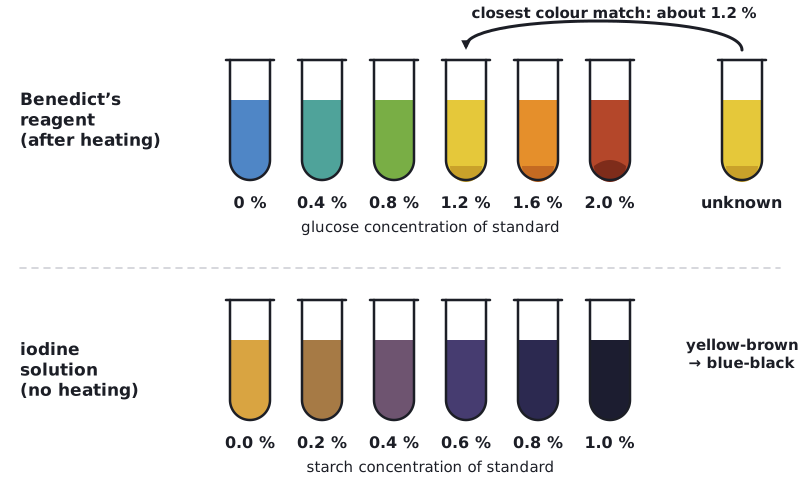 (opens full size in a new tab)
Written and checked against the Edexcel International A Level Biology (YBI11) specification · Updated October 2026