
Oxidative phosphorylationSpec 7.4
In short
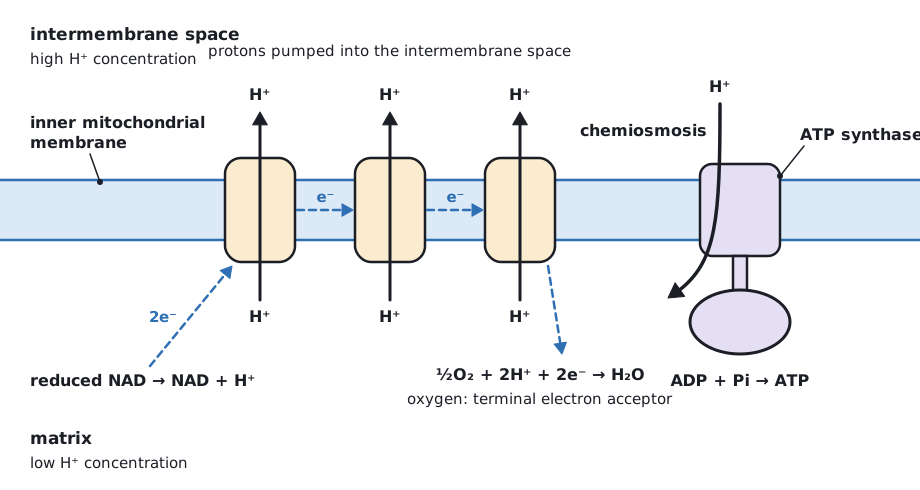
Oxidative phosphorylation makes ATP using energy released as electrons pass along the electron transport chain on the inner mitochondrial membrane. This energy pumps protons into the intermembrane space; protons flow back through ATP synthase by chemiosmosis, driving ADP and phosphate to ATP. Oxygen is the final electron acceptor.
Most ATP is made by oxidative phosphorylation, which is linked to the electron transport chain on the inner mitochondrial membrane. The folded cristae give a large surface area for the carriers and ATP synthase.
- Reduced NAD and reduced FAD deliver hydrogen to the chain. They are oxidised back to NAD and FAD, which can be used again in glycolysis, the link reaction and the Krebs cycle. The hydrogen splits into protons (H⁺) and electrons.
- The electrons pass along a chain of electron carriers in a series of redox reactions. Each step releases a little energy.
- This energy is used to pump protons from the matrix into the intermembrane space, building up a high concentration of H⁺ there: a proton gradient across the inner membrane.
- Protons diffuse back into the matrix down their gradient through channels in the enzyme ATP synthase. This flow of protons is called chemiosmosis, and it provides the energy to join ADP and inorganic phosphate (Pi) to form ATP.
- At the end of the chain, oxygen is the final electron acceptor. It combines with electrons and protons to form water.
| Stage | Site | ATP made directly | Reduced NAD | Reduced FAD |
|---|---|---|---|---|
| Glycolysis | Cytoplasm | 2 (net) | 2 | 0 |
| Link reaction | Matrix | 0 | 2 | 0 |
| Krebs cycle | Matrix | 2 | 6 | 2 |
| Oxidative phosphorylation | Inner membrane | Most of the ATP (from reduced NAD and FAD) | Oxidised | Oxidised |
Without oxygen the chain stops. Reduced NAD and reduced FAD are not oxidised, so NAD and FAD run out, and the link reaction and Krebs cycle also stop.
 (opens full size in a new tab)
Written and checked against the Edexcel International A Level Biology (YBI11) specification · Updated October 2026