
Negative and positive feedbackSpec 7.16
In short
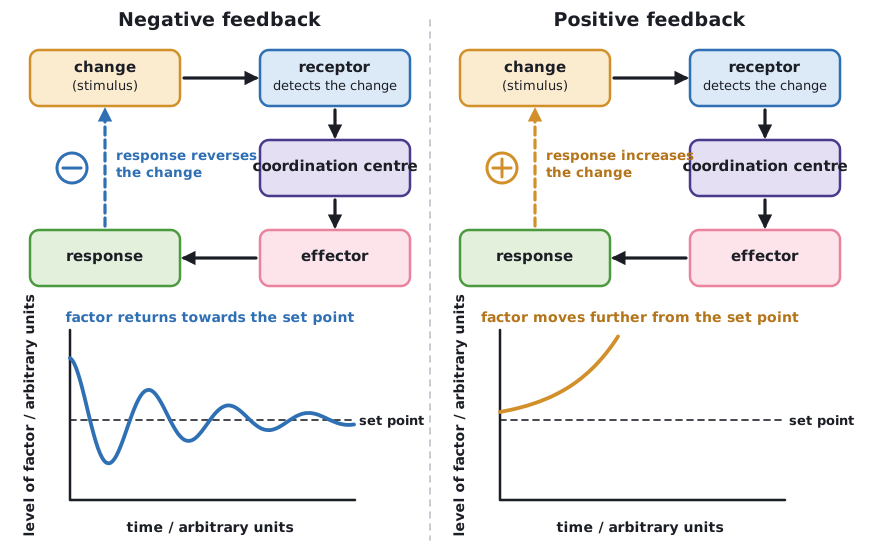
Negative feedback is a control mechanism in which a change in a factor is detected and corrected, returning it towards its set point, so the factor stays within narrow limits. In positive feedback, a change leads to responses that increase the change further, moving the system away from its starting point.
Most control systems in the body contain the same components: a receptor detects a change in a factor, a coordination centre (for example the hypothalamus) processes the information, and an effector (a muscle or gland) brings about a response.
Negative feedback
In negative feedback, the response reverses the original change. If the factor rises above the set point, the response makes it fall; if it falls below, the response makes it rise. The factor therefore fluctuates around the set point within narrow limits. Having receptors and effectors that work in opposite directions (for example vasoconstriction and vasodilation) gives control in both directions.
- A factor changes from its set point (the stimulus).
- Receptors detect the change and send information to the coordination centre.
- The coordination centre sends signals (nerve impulses or hormones) to effectors.
- Effectors produce a response that reverses the change.
- The factor returns to its set point and the stimulus is removed, so the response is switched off.
Positive feedback
In positive feedback, the response increases the change away from the set point. It is not used to maintain a steady state. It is useful when a rapid, complete change is needed, for example the stimulation of uterine contractions by oxytocin during birth, and the opening of voltage-gated sodium channels in an action potential. If it is not stopped it can be harmful.
'Negative' does not mean the effect is bad or that the response decreases the factor. Negative feedback reverses whichever change occurred. Positive feedback amplifies it.
 (opens full size in a new tab)
Written and checked against the Edexcel International A Level Biology (YBI11) specification · Updated October 2026