
Sclerenchyma fibres, xylem vessels and phloemSpec 4.5
In short
Sclerenchyma fibres give support, xylem vessels support the plant and transport water and mineral ions upwards, and phloem translocates organic solutes such as sucrose. Fibres and vessels are dead, lignified cells, whereas sieve tube elements are living cells with companion cells. In a dicot stem all three tissues lie in vascular bundles.
These three tissues are all elongated cells arranged in strands that run along the length of roots and stems. Know where they are in the stem, what their cells look like and what they do.
| Feature | Sclerenchyma fibres | Xylem vessels | Phloem (sieve tubes and companion cells) |
|---|---|---|---|
| Function | Support (mechanical strength) | Support and transport of water and mineral ions | Translocation of organic solutes (mainly sucrose and amino acids) |
| Living or dead at maturity | Dead | Dead | Sieve tube elements living; companion cells living |
| Cell wall | Thick, lignified secondary wall; narrow lumen | Thick lignified secondary wall in rings, spirals or nearly continuous layers; pits | Thin cellulose walls, not lignified |
| Cell contents | None | None; hollow lumen, no end walls between vessel elements, forming a continuous tube | Sieve tube: little cytoplasm, no nucleus, few organelles; sieve plates with pores at the ends. Companion cell: dense cytoplasm, nucleus, many mitochondria |
| Cell shape | Very long, narrow, tapered ends overlapping | Long, wide tubes joined end to end | Sieve tube elements joined end to end; companion cell alongside each |
| Direction of flow | Not applicable | One direction only: upwards from roots | Both directions, from sources to sinks |
| Position in a dicot stem | In a cap on the outer side of each vascular bundle, and as a ring or patches towards the outside of the stem | Inner (central) side of each vascular bundle, towards the pith | Outer side of each vascular bundle, between the xylem and the sclerenchyma |
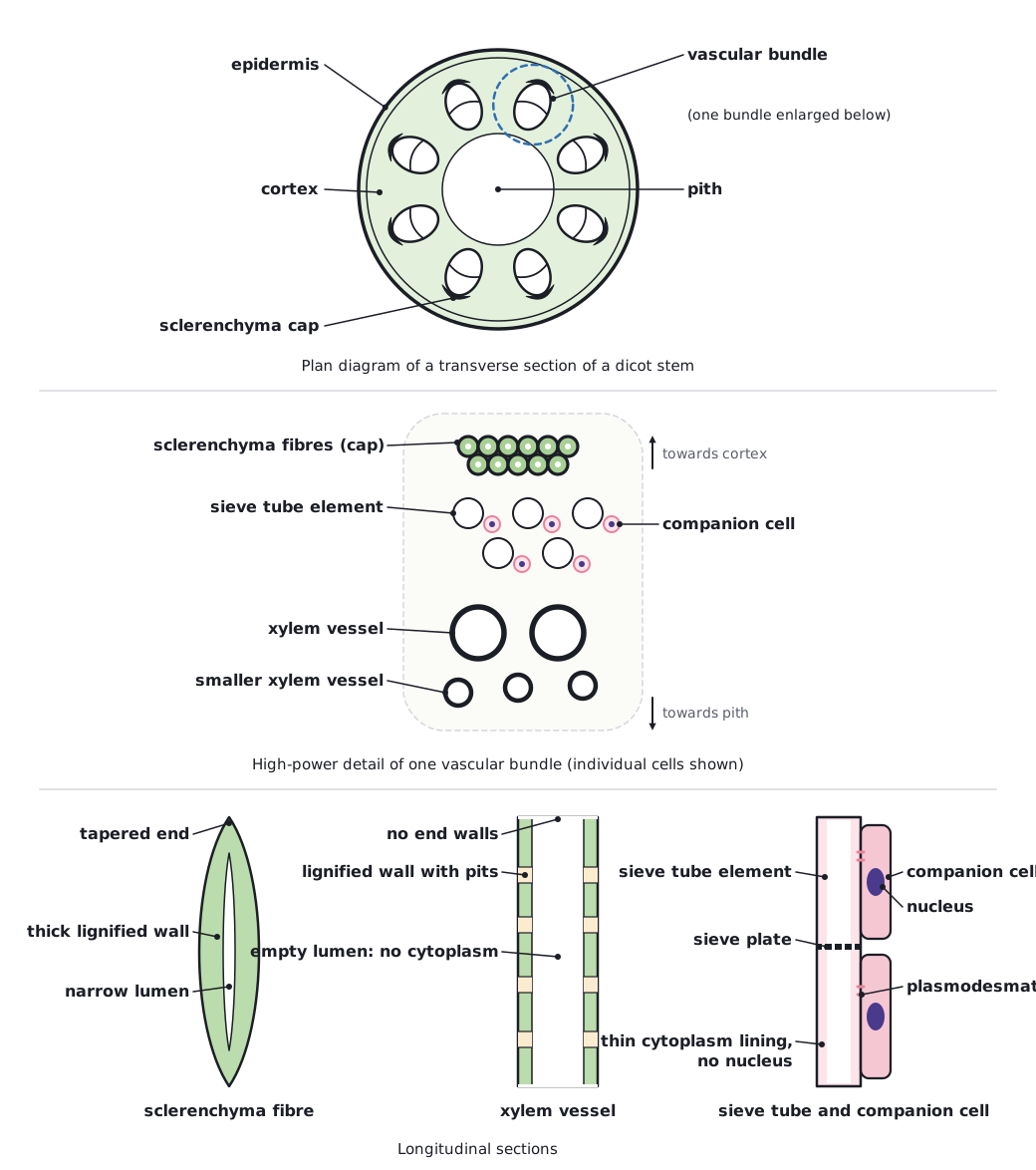 (opens full size in a new tab)
Similarities
- All three are elongated cells arranged end to end or side by side.
- Fibres and xylem vessels both have thick lignified walls and are dead when mature.
- All three are found in the vascular bundles (fibres also outside them).
- Fibres and xylem vessels both support the plant; phloem does not have a support role.
Roots and leaves
In a root the xylem forms a central star or cross shape, with phloem between its arms, which helps the root resist pulling forces. In a leaf, the vascular bundles in the midrib and veins have xylem on the upper side and phloem on the lower side.
In stems, remember the order from the centre outwards: pith, xylem, phloem, sclerenchyma cap. Questions often ask you to name a tissue from its position and description.
Written and checked against the Edexcel International A Level Biology (YBI11) specification · Updated October 2026