
Osmosis and water potentialSpec 2.4
In short
Osmosis is the net movement of free water molecules through a partially permeable membrane, down a water potential gradient, from a region of higher water potential to one of lower (more negative) water potential. Water potential is measured in kilopascals, and pure water has a water potential of zero.
Water potential (symbol ψ, the Greek letter psi) is a measure of the tendency of water molecules to move from one place to another. It is measured in kilopascals (kPa). Pure water has the highest water potential, which is defined as zero. Dissolved solutes attach to some of the water molecules, so fewer water molecules are free to move. Adding solute lowers the water potential, so the water potential of any solution is negative.
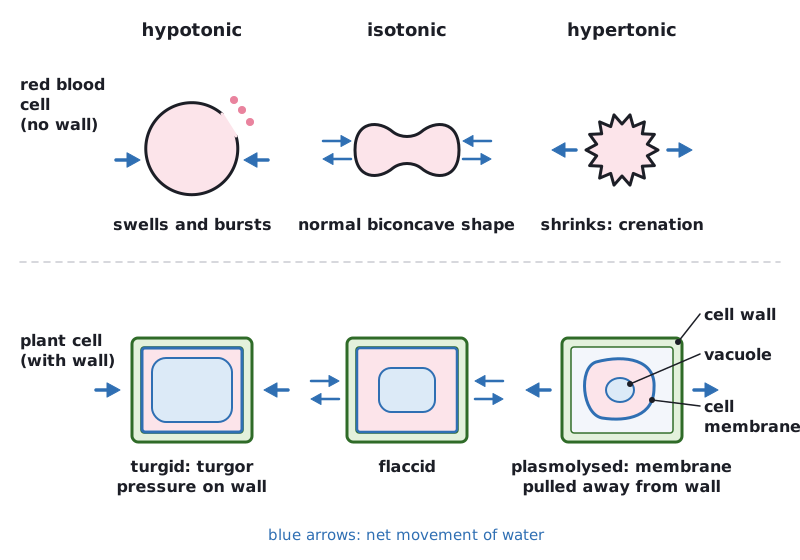
Osmosis is the net movement of free water molecules through a partially permeable membrane, down a water potential gradient. Water molecules move in both directions across the membrane, but more move from the region of higher (less negative) water potential to the region of lower (more negative) water potential. Osmosis is a passive process and needs no ATP.
| Solution compared with the cell | Net movement of water | Animal cell (no cell wall) | Plant cell (cellulose cell wall) |
|---|---|---|---|
| Higher water potential (more dilute, such as pure water) | Into the cell | Swells and may burst (lysis). | Swells until the wall resists: turgid. |
| Same water potential | No net movement | Stays the same. | Stays the same. |
| Lower water potential (more concentrated) | Out of the cell | Shrinks and the surface looks shrivelled (crenation). | Cytoplasm shrinks and pulls away from the cell wall: plasmolysed. |
Recommended practical: tissue water potential using plant tissue
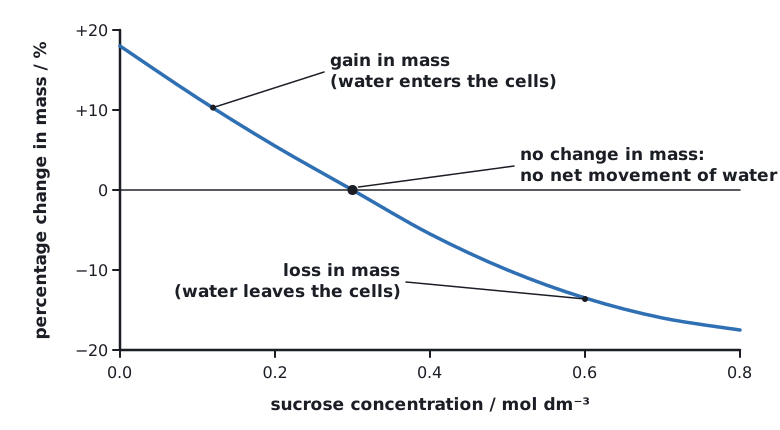
The specification recommends an investigation of tissue water potentials using plant tissue and graded concentrations of a solute. Cylinders of potato are cut to the same size, blotted, weighed, left in sucrose solutions of different concentrations for the same time, then blotted and weighed again. In dilute solutions the cylinders gain mass; in concentrated solutions they lose mass.
Percentage change in mass
A potato cylinder has a mass of 2.40 g before and 2.70 g after 24 hours in a sucrose solution. Calculate the percentage change in mass.
- Change in mass = 2.70 − 2.40 = +0.30 g.
- Divide by the initial mass: 0.30 ÷ 2.40 = 0.125.
- Multiply by 100: 12.5 %.
Answer: +12.5 % (an increase, so water entered by osmosis).
Plot percentage change in mass (y axis) against sucrose concentration (x axis). Where the line crosses zero, there is no net movement of water, so the water potential of the potato tissue equals that of the solution. Read off the concentration at the intercept, then use a calibration table to find the water potential.
Control the size of the cylinders, the volume of solution, the time, the temperature and the way the pieces are blotted. Use percentage change rather than change in mass, so that pieces of slightly different starting mass can be compared.
Do not say water moves 'from a high concentration of water to a low concentration of water'. Say 'from a higher (less negative) water potential to a lower (more negative) water potential'. And keep the sign: −200 kPa is a higher water potential than −500 kPa.
 (opens full size in a new tab)
 (opens full size in a new tab)
Written and checked against the Edexcel International A Level Biology (YBI11) specification · Updated October 2026