
The overall reaction and the role of ATPSpec 5.1, 5.2
In short
Photosynthesis is the process in which light energy is used to split water molecules, and the hydrogen is combined with carbon dioxide to make glucose, a fuel, while oxygen is released. ATP is made from ADP and phosphate using light energy, and its hydrolysis gives an immediate supply of energy.
The overall reaction is a redox reaction. Light energy is used to break the strong bonds in water molecules (photolysis). The hydrogen from the water is stored in a fuel, glucose, by combining it with carbon dioxide. Oxygen is released into the atmosphere as a by-product.
Carbon dioxide is reduced (it gains hydrogen) and water is oxidised (it loses hydrogen and electrons). The oxygen released comes from water, not from carbon dioxide. This can be shown by supplying plants with water labelled with the isotope oxygen-18: the oxygen gas given off is labelled, but the glucose is not. The summary equation above hides this, because 6 water molecules hold only 6 of the 12 oxygen atoms in 6O₂. A more accurate equation is 6CO₂ + 12H₂O → C₆H₁₂O₆ + 6O₂ + 6H₂O, in which all the oxygen gas comes from water.
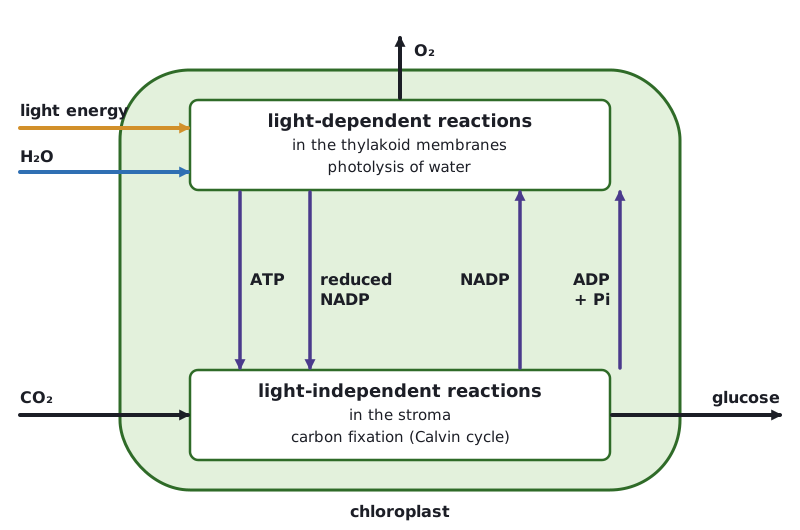
The reaction is not carried out in one step. Light energy is first used in the light-dependent reactions to make ATP and reduced NADP. These are then used in the light-independent reactions to reduce carbon dioxide to sugars.
 (opens full size in a new tab)
ATP (adenosine triphosphate) is the immediate source of energy for biological processes. When the terminal phosphate bond is hydrolysed, ATP becomes ADP and inorganic phosphate (Pi) and a small, usable amount of energy is released. This is done in one step, catalysed by ATP hydrolase (ATPase), so energy is available quickly and in amounts the cell can use.
In photosynthesis, the ADP is converted to ATP by photophosphorylation: the addition of phosphate to ADP using light energy. This requires energy because the reaction ADP + Pi → ATP is endergonic. The ATP made in the light-dependent reactions is hydrolysed in the light-independent reactions to power the reduction of carbon dioxide.
Say that photophosphorylation uses light energy to add phosphate to ADP. Do not say that ATP stores or 'makes' energy: it releases energy when it is hydrolysed.
Written and checked against the Edexcel International A Level Biology (YBI11) specification · Updated October 2026