
Sensory, relay and motor neuronesSpec 8.1
In short
Sensory neurones carry impulses from receptors to the central nervous system, relay neurones connect neurones within it, and motor neurones carry impulses from it to effectors. Many axons are wrapped by Schwann cells, which form an insulating myelin sheath that speeds up conduction.
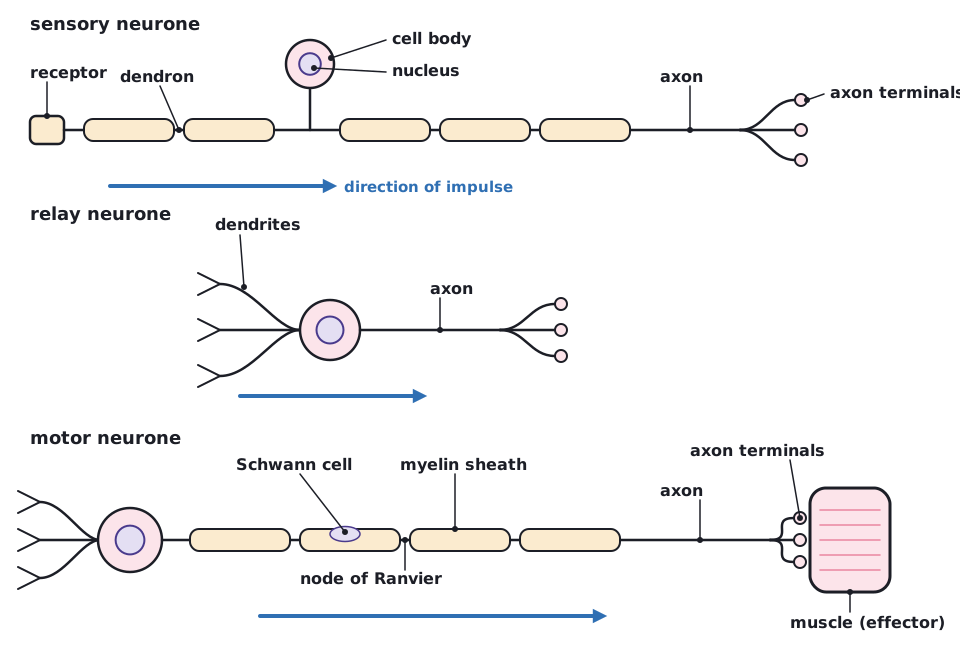
A neurone is a nerve cell specialised to conduct nerve impulses (action potentials) as rapid electrical signals. Each has a cell body containing the nucleus and organelles, extensions called dendrites or a dendron that carry impulses towards the cell body, and a long axon that carries impulses away from it. There are three types, which differ in structure because their jobs and positions in a pathway differ.
| Feature | Sensory neurone | Relay neurone | Motor neurone |
|---|---|---|---|
| Function | Carries impulses from a receptor to the central nervous system (CNS) | Carries impulses between sensory and motor neurones, entirely inside the CNS | Carries impulses from the CNS to an effector (a muscle or gland) |
| Position of cell body | Just outside the spinal cord, in a swelling of the dorsal root called the dorsal root ganglion; the cell body sits to one side of the long fibre | Inside the CNS, in the grey matter | Inside the CNS, in the grey matter; the cell body is at the start of the neurone |
| Dendrites and axon | One long dendron brings impulses from the receptor to the cell body; a shorter axon takes them into the CNS | Many short processes, with numerous dendrites and a short axon, giving many synapses | Many short dendrites on the cell body; one very long axon runs out to the effector |
| Myelin | Axon and dendron usually myelinated | Often unmyelinated or with a thin sheath because the distances are short | Axon usually myelinated, allowing fast conduction over a long distance |
 (opens full size in a new tab)
Schwann cells are glial cells that wrap their plasma membrane many times around an axon in the peripheral nervous system. The layers of membrane are rich in lipid, and together they form the myelin sheath. Myelin is an electrical insulator: ions cannot cross it. The sheath is interrupted by small gaps, about 1 mm apart, called nodes of Ranvier, where the axon membrane is exposed. Schwann cells also support the axon and help to repair it if it is damaged.
Describe the structure and the function for each neurone. A common mark is for the position of the cell body: sensory cell body in the dorsal root ganglion, relay and motor cell bodies in the grey matter of the CNS.
Written and checked against the Edexcel International A Level Biology (YBI11) specification · Updated October 2026