
Predicting climate change: extrapolation and modelsSpec 5.19
In short
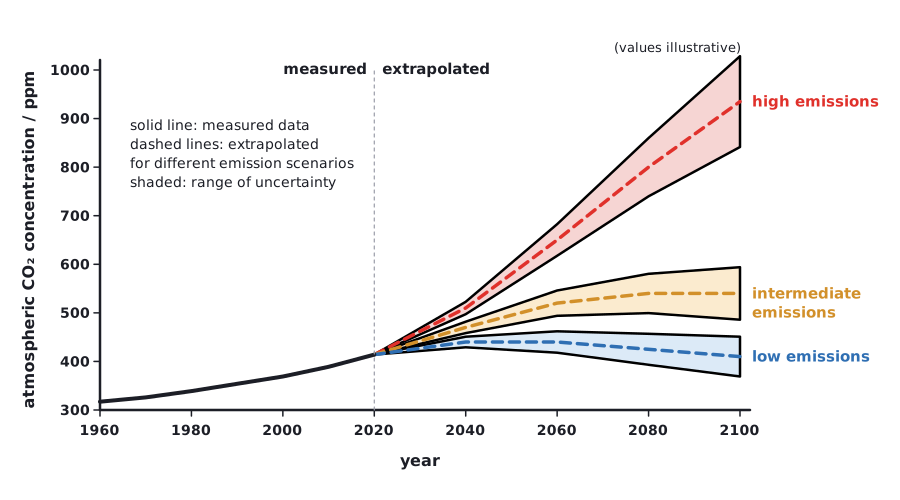
Extrapolation extends a trend in existing data beyond the range measured to make predictions, and these predictions are built into mathematical models of future climate change. Models have limitations: the climate is a complex system with many interacting factors and feedback loops, data are incomplete, and predictions depend on assumptions about future emissions.
Extrapolation means extending a line or curve beyond the measured data to predict what might happen in the future. Predictions are used in models of future climate change, which use data on greenhouse gas concentrations, temperature, ice cover and ocean currents to estimate how much warming might occur under different assumptions (for example scenarios of high or low emissions).
 (opens full size in a new tab)
Limitations of models
- The climate is a complex system with many interacting factors (oceans, clouds, ice, vegetation, volcanic activity), and it is not possible to include them all accurately.
- Models contain feedback loops, which are hard to represent. Positive feedback increases the change: for example, melting ice exposes darker surfaces that absorb more heat; warming thaws permafrost and releases methane. Negative feedback reduces change: for example, more CO₂ may increase plant growth.
- Data may be incomplete or unreliable, especially for the past and for remote areas, and small errors in the data are amplified in the predictions.
- Extrapolation assumes that the trend continues as it has done, which may not be true. Predictions depend on assumptions about future human behaviour, such as emissions and population growth, which cannot be known.
- Different models give different predictions, so there is uncertainty. A model can be tested by checking whether it reproduces known past climates.
A 'limitation' needs a reason. Write 'the model may not predict accurately because it cannot include all the variables, such as feedback from melting ice' rather than just 'models are not accurate'.
Written and checked against the Edexcel International A Level Biology (YBI11) specification · Updated October 2026